Springtime in Full Bloom at Texas State Parks
News Release – News Images
Media Contact: Rob McCorkle, 830-866-3533, robert.mccorkle@tpwd.state.tx.us
March 8, 2012
AUSTIN – What looks to be a promising wildflower season has started early this year and Texas State Parks remain some of the best and safest places to see and photograph a dazzling array of bluebonnets, mountain laurels and other blooming flora.
This comes as good news for wildflower fans on the heels of last year's record-setting heat wave and drought that make wildflower season a bust throughout most of a state that boasts more than 5,000 wildflower species. Most parts of Texas as of late, however, are benefiting from the late fall and winter rains and warmer-than-normal January and February temperatures.
Texas Parks and Wildlife Department botanists and state park natural resources specialists concur with Lady Bird Johnson Wildflower Center's prediction of an impressive wildflower season thanks to well-timed moisture in central, eastern and northern parts of Texas.
Even in drought-stricken West Texas, state park field reports show exceptions to the rule of a poor wildflower showing.
"The rains and snow, coupled with recent suitable temperatures have proven to be the perfect combination for a beautiful and prolific Mexican gold poppy blooming season," reports Adrianna Weickhardt, interpretive ranger for Franklin Mountains State Park in El Paso. "We'll be celebrating with the Poppies Festival at nearby Castner Range on March 31."
"It's a great spring in East Texas," says TPWD botanist Jason Singhurst, who has been seeing lots of sandyland bluebonnets (Lupinus subcarnous) that are expected to reach full bloom in coming weeks.
Singhurst also looks for good crops of Texas groundsel, bluets, white trout lily, mayapples and other flowering flora in the piney woods and post oak savannah of East Texas. He recommends Lake Somerville State Park and Trailway, and Tyler and Purtis Creek state parks as good wildflower-viewing locations in East Texas.
TPWD botanist Jackie Poole concurs with her fellow botanist about a promising wildflower season and notes "some weird things happening" where spring bloomers are concerned around Austin.
"Texas mountain laurels already have bloomed ahead of agarita and Mexican buckeye that usually come first," Poole says. "The drought may be causing some species to flower earlier or later than normal, but I've got a great crop of bluebonnets, as well as many other species, in my yard. Give us some sunny, warm days and things will really start to pop."
Sandy soils typically produce some of the better wildflower displays, according to Poole, so wildflower lovers in central Texas should consider visiting Palmetto and Inks Lake state parks, as well Enchanted Rock State Natural Area north of Fredericksburg.
Just outside Bandera, park staff report "Hill Country State Natural Area has put on her spring bonnet with purple mountain laurel, hot pink redbuds and bright yellow agarita bushes all ablaze. The fragrances are fabulous and the wildflowers are just starting up and promise to be in full bloom after early spring rains and sunny days."
A healthy crop of bluebonnet rosettes spotted in mid-February are now starting to bloom in Goliad State Park, where spring arrived early, and park ranger Tammy Zellner promises "somewhat of a bumper crop this year." In addition, she reports pink evening primrose, winecup, blue-curls and Indian paintbrush are starting to put on blooms.
In parts of central and north Texas, Texans are already being treated to the colorful blooms of such flowering trees as redbuds, peach, pear and Mexican plum. Judging from the profusion of pink blooms on peach trees recently spied around Fredericksburg and Stonewall, barring an unpredictable late spring freeze, peach lovers are in for a mouth-watering season.
Wildflower season at Lyndon B. Johnson State Park & Historic Site takes on special meaning this year during Texas' year-long celebration of the 100th birthday of one of the state's biggest wildflower champions, Lady Bird Johnson, who would have turned 100 years old this December. LBJ Park Superintendent Iris Neffendorf expects showy displays of bluebonnets, Indian paintbrush and other along park trails and roads.
In honor of Mrs. Johnson, the park has installed a new wildflower display inside the Visitors Center to help with wildflower identification along the park's nature trail that Lady Bird helped get developed and frequently strolled. On May 5 and 12, park will host a guided nature walk to highlight its flora, fauna and history.
Some of the most eye-popping wildflower crops to be viewed year-in, year-out are found in rolling, verdant Washington County. Washington-on-the-Brazos State Historic Site between Brenham and Navasota offers great wildflower diversity among 293 acres of natural riverside beauty, as well as an informative primer on early Republic of Texas history. Rewarding patches also can be seen near Houston at Brazos Bend andGalveston state parks.
For updated statewide wildflower reports, visit the Texas Department of Transportation's Web site or call 1-800-452-9292 that details where noteworthy stands of wildflowers have been sighted along the state's highways.
Additional field reports this week from park staff:
WEST TEXAS
San Angelo State Park – Fairly decent rainfall as well as some snow have resulted in blankets of bladderpods, small patches of plains yellow daisy, Dutchman breeches, windflower and fringed puccoon. Smaller flowering plants, such as peppergrass, cranesbill and henbit are becoming abundant as well.
GULF COAST
Mustang Island State Park – We have some beach evening primrose lighting up the dunes.
Goose Island State Park – We should have somewhat of a bumper crop this year. The field behind the Rec Hall is covered in bluebonnets and wildflowers are sprouting all over the Lamar Peninsula.
HILL COUNTRY
Colorado Bend State Natural Area – There are some serious mountain laurel displays and we're expecting the bluebonnet crop to be great.
Enchanted Rock State Natural Area – Bluebonnets are coming out and should be in full bloom within the next couple of weeks, and the Mexican redbud and mountain laurels are blooming.
Government Canyon State Natural Area – Wildflower season is in full swing. Currently, the hills and savannah are covered in a mix of golden-eye phlox and prolific displays of low bladderpod. Bluebonnets are just beginning to open and will be in full bloom within the next week or two.
Lost Maples State Natural Area – Mountain laurels are putting on blooms.
McKinney Falls State Park – Bluebonnets starting to bloom.
South Llano River State Park – The wildflowers are just getting started, but right now, we have prairie verbena and agarita blooming. In the next few weeks, redbuds should be blooming and shortly thereafter the mountain laurels should join the verbena in an awesome show.
SOUTHEAST TEXAS
Wildflowers appear to be abundant in most parks in this region, but peaking about two weeks earlier than normal. Right now, flatwoods plums and redbuds are in full bloom at Huntsville and Stephen F. Austinstate parks.
NORTH TEXAS
Dinosaur Valley State Park – Bluebonnets will be the major flower here.
Cedar Hill State Park – We have done several prescribed burns of Blackland Prairie remnants at the sound end of the park. Typically, this results in an extra special mix of wildflowers, including wild foxglove, prairie celestials, wild hyacinth and Engelmann's daisy, lasting through spring months.
Ray Roberts Lake State Park and Greenbelt – At this time, visitors are seeing oft-overlooked, but lovely early spring wildflowers such as small bluets, spring beauty, vetch and crow poison, as well as blooming Mexican plum trees. Soon to show their blooms will be bluebonnets, Indian blanket, fire wheels, pink evening primrose, prairie spiderwort, dotted blue-eyed grass, Drummonds wild onion, lemon bee balm, brown-eyed Susan and green wild indigo .
EAST TEXAS
Purtis Creek State Park – We should have bluebonnets in bloom this month. There's a large patch at the office, should be blooming sporadically throughout the park, along with Indian paintbrush and other species.
———
For all your San Antonio real estate needs
 Good compost can be purchased in bags from your local garden centers or even Walmart. (It takes 14 bags of compost to equal 1 cubic yard.) You can save a lot of money if you buy in bulk directly from the materials yard to be delivered or if you have a pickup truck you can haul 1 to 3 cubic yards at a time yourself.If you purchase bulk compost or top-dressing it will cost approximately $30 a cubic yard plus delivery which should be between $50 and $150 depending on the amount ordered and how far you live from the materials yard you have ordered from.
 Having a couple of dogs and a garden works very well at getting one out from behind a desk and a computer ... in that one of them – well, both of them – need to be watered frequently. The dogs must be walked, and the garden needs to be weeded and mulched. All these things must be performed often enough that anyone who has either or both is no danger of becoming fused to the task chair...
 So – anyway, it's clear that spring has come early to the
 The leggy kerria japonica shrub by the side gate has been blooming frantically this week, and around our neighborhood, the iris and roses are in fine fettle. The rain has been good for the lawns – even the most neglected of them is now lush and green ... with ragweed and dandelions. There are maybe four or five lawns in the neighborhood whose owners nailed their banner to the mast and kept green, all last year; now, they look even better than ever, and the best of them look like something on the front cover of Country Living.
 This weekend, we were hungry for a small bite of lunch – nothing too heavy, more of a snack, really – and my daughter spotted a place called "Tiger Pop", out near the
 We were walking the dogs the other day when we saw a bucket truck parked in front of a house down the road. There was a worker with a long rope and a chain-saw, busy taking down some higher branches. When we got closer, we saw that there were already the remains of a great many large tree limbs piled up in front of the house. And that the bucket-truck was actually one of those covered dump-truck arrangements used by tree services, with a portable industrial wood-chipper hitched to the back of the truck. One of our neighbors was obviously having a great deal of work done on the trees in their yard – only one of which was a deciduous tree.
 This was too good to pass up. I ripped out the grass around my house years ago, and went to xerioscape plantings, with stone pathways and edgings of reclaimed stone from building sites. A goodly portion of my garden needed mulch, and in quantities too substantial for me to afford, even at $2.50 a bag from Lowe's ... and we were not keen on trekking down to the
  "We need a lot!" I said, and so at around three o'clock, he came around with the bucket/dump truck, my daughter moved her car out of the driveway, and he deposited something like six cubic yards of mulch in the driveway. It made a nice pile – so much that we had to leave her car on the street until we could reduce the pile somewhat; which we began to do, Friday morning. One of our neighbors lent us her wheelbarrow; and we set to work. About three hours of shifting mulch by any means was about as much as we could handle, but we had reduced the Matterhorn of Mulch by about two thirds. My daughter and I disagreed about the priorities: I wanted to mulch the back yard first; the part that we look at all the time, where the patio is, and where all the vegetable plantings are. My daughter insisted that no, the front was the part that everyone else saw ... and it was getting to look embarrassingly low-rent and unkempt.
 "We don't want to be 'those people,'" my daughter insisted – and as she had a shorter distance to transport the mulch, the largest part did finish up in the front. But there was so much that most of the back yard got a good share, at least the parts that I wanted to see well-covered.
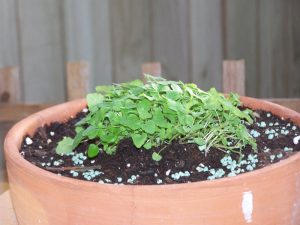
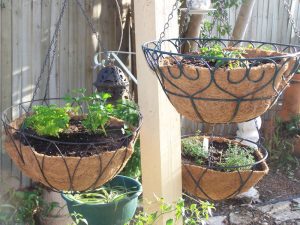 Yes, we know very well that the official date for 'last frost o' the season' for San Antonio is March 15th – but the trees are tentatively beginning to put on new leaves, the new grass – or what passes for the grass in weedy fields and verges – is already thick and green, and so it is time to get back to the garden. The suppliers have gotten the early spring vegetables starts in already. So – we went out this last weekend to get started in a bigger way, especially since the early lettuce and greens that we put in pots a couple of weeks ago did very nicely.
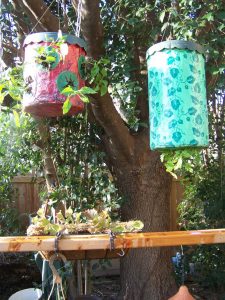
 The topsy-turvy planters had been emptied of last year's plants and the soil; we were so encouraged by the success of growing peppers and tomatoes last year that visions of beans, eggplant, zucchini and more tomatoes are dancing in our heads. It's time to start with the seasonal herbs again, things like basil, which never, ever last through the winter. Sorry – the first time the temperature drops below 40 degrees, the basil is gonna croak, and hauling the pot indoors will not help. After (gulp) thirty years of growing herbs on balcony, back garden, or patio, this is akin to accepting that the sun will come up in the morning and go down in the evening.
 Last fall, we found three earth box planters put out on the curb for bulk trash pick-up. I guess someone was going to move, or had just said the heck with growing mass quantities on the back porch, so we took them to our
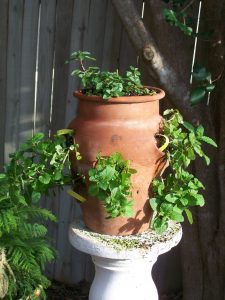
  We did over-spend on plants. Lettuce and greens; eight tomato plants, some cardoons and an artichoke; I so love artichokes, very likely I will go back and buy some more. Herbs; oregano, parsley – two kinds of each, and my daughter discovered all the different kinds of mint that there are at the Antique Rose Emporium. Mint is an invasive plants – as persistent and unkillable as kudzu or crab-grass once established, although the various disasters that my back yard has been heir to for the last five years has eradicated the mint that I once had growing wild in the ground. Among the army of empty pots is a strawberry urn, with the eight little side pockets ... which we have tried to plant twice times: first time with strawberries, of course.
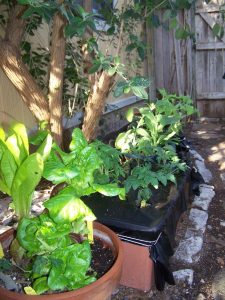 Second time my daughter had a go with mixed herbs – with disastrous results. Oh, the plants did very well at first, but the trouble is that the water runs into the top of the pot and carries out the soil through all the little pockets. You have to water the darned thing pretty often, because of all the plants in it – but this time, my daughter had an 'ah-hah!' moment, considering the sheer, persistent toughness and durability of mint, and I suggested cutting circles of coir matting, with a slit in it and a small opening for the plant stem. So, my daughter spent her money on different flavors of mint plants – and some coir inserts – and we'll see if the third time is the charm.