by Julia Hayden
Goliad - The Other Alamo
 The Texas war for independence from Mexico kicked off 175 years ago - but that it barely lasted six months, and crammed the most spectacular events into a period of about seven weeks means that the commemorative events are similarly crammed. The first weekend in March took me to the Alamo . . . and the last weekend will take me to the Goliad, or La Bahia del Espiritu Santo. Of all those places the Texas revolution happened, La Bahia is the only one which still looks much like it did in 1836.
 In the matter of retaking Texas, Santa Anna had detached General Don Jose Urrea, with a force of about a thousand soldiers to guard his eastern flank and to mop up the Anglo-Texan resistance along the coastal plains. Colonel James Fannin with 500 men - the largest portion of what military the Texian rebels possessed - were at Goliad, which commanded the strategic route from the coastal port at Copano. Meanwhile, spurred by the knowledge that they must either fight or go under, a convention of Texian settlers at Washington-on-the-Brazos declared independence on March 2. In double quick-time, they had drafted a constitution, elected an interim government, and commissioned Sam Houston as commander of what army was left. Houston went to rally the settlers' militia at Gonzales, intending to relieve the Alamo; on the day of his arrival news came that the Alamo had fallen.
 Houston sent a message to Fannin, ordering him to fall back towards the east, but Fannin had sent out a small force to protect Anglo-Texan settlers nearby, and refused to leave until he heard from them. When he did finally move out, Urrea's column had already made contact. Fannin and his force were caught in the open a little short of Coleto Creek. They fought in a classic hollow square, three ranks deep for a day and a night, tormented by lack of water. Finally, Urrea brought up field guns, and raked the square with grapeshot. Fannin surrendered, believing that he did so under honorable terms.
 The survivors were brought back to Goliad and held for a week. They all assumed they would be disarmed, paroled and sent back to the United States. Urreas' officers had assumed the same, and were appalled when Santa Anna ordered that the prisoners be executed. Urrea had asked for leniency and the commander left in charge of Goliad was personally horrified, but the orders were obeyed. On Palm Sunday, 1863, those of Fannin's garrison able to walk - about three hundred of them - were divided into three groups, and marched out of town in three different directions, before being shot down by their guards.
Forty wounded were dragged into the courtyard in front of the chapel doors and executed as they lay on the ground. Fannin himself was shot last of all, knowing what had happened to his men. Many bodies were dumped into a trench and burnt, although most were left where they lay. A handful of Texians survived by escaping into the brush during all the confusion, and another handful were kept out of the fatal march - concealed by sympathetic Mexican officers or rescued by Francita Alavez, the Angel of Goliad.
There will be a reenactor's encampment within the walls of the presidio this weekend, March 26 and 27, 2011 and a number of scheduled events, in addition to a memorial service on Sunday. More is at the linked website.
Presidio La Bahía is located one mile south of Goliad, Texas on U.S. Highway 183 (77A). Presidio La Bahia was established at this location in 1749, with Mission Espíritu Santo
26th ANNUAL GOLIAD MASSACRE LIVING HISTORY PROGRAM
SCHEDULE FOR THE EVENT - 2011
SATURDAY, March 26th
9:00 GATES OPEN
10:00 1ST SKIRMISH
10:30 LIVING HISTORY AT CAMPSITES
10:30 CAVALRY PRESENTATION AT AMPHITHEATER
11:00 LECTURE IN CHAPEL
12:00 SHOWING OF VIDEO "PRESIDIO LA BAHIA AND ITS PLACE IN THE
HISTORY OF TEXAS" IN CHAPEL
12:30 Concert by K.R. Wood and the Gone to Texas Band in chapel.
1:30 2ND SKIRMISH
2:00 LIVING HISTORY AT CAMPSITES
2:15 LECTURE IN CHAPEL
3:00 BATTLE OF COLETO CREEK
3:30 LIVING HISTORY AT CAMPSITES
5:00 GATES CLOSE
7:00-9:00 CANDLELIGHT TOUR - ENTER AT SOUTH GATE
SUNDAY, March 27th
9:00 GATES OPEN
9:30 ISAAC HAMILTON - A PRISONER BY DENNIS REIDESEL
10:00 DEATH MARCH FROM CHAPEL TO ACTUAL MASSACRE SITE
Followed by ISAAC HAMILTON - A SURVIVOR BY DENNIS REIDESEL
Followed by EXECUTION OF FANNIN AND THE WOUNDED TEXIANS
Followed by MEMORIAL SERVICE STARTS IN CHAPEL FOLLOWED BY A
PROCESSION TO THE FANNIN MONUMENT FOR THE CONCLUSION
OF THE MEMORIAL SERVICE.

 The rivers that run through Texas were not historically reliable enough to facilitate heavy transport in the way that the Mississippi and its various tributaries were and still are. The various rivers - Rio Grande, Nueces, Guadalupe, San Antonio, Sabine, Brazos and Trinity - were at times and in places navigable by shallow-draft boats and steamships - it all rather depended on how recently it had rained. They were slightly more useful at providing small-scale power for mills, at those points where they could be built. But the most important use for Texas rivers though, especially the western-most of them - was simply that they were there, providing water in an otherwise arid land.
 San Antonio was located where it was because of the generous sources of sweet, cold water - springs of which came out like fountains because of the aquifer, buried deep under the limestone hills to the north. Travelers and memoirists alike noted the importance of water and the river to San Antonio, even in the early days. By mid-19th century, it was noted that the very best houses in town backed on the river, with bath-houses and pavilions built along the banks, and in the heat of summer, practically everyone found relief from it by soaking in the water. After the Alamo, San Antonio's premier tourist attraction is - of course - the Riverwalk. Out of the spotlight, there are a number of projects to extend various existing parks and construct new recreational greenways along the banks of urban rivers and creeks - but that's a year round and on-going project. The major summertime enjoyment of other local rivers is just about to be launched, with a large and refreshing splash.


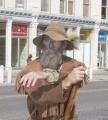
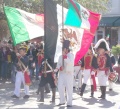
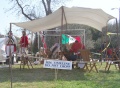
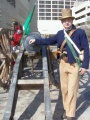 I'm not alone in this mad love of history, in being so besotted by events and eras to the point of studying certain aspects down to the sub-atomic level. I only write about it, which is the traditional venue for those like Miniver Cheevy, who wistfully believe they were born too late. There have been writers who have done very well by antiquarian enthusiasms; Sir Walter Scott almost single handedly popularizing the sport of jousting in mid-19th century England and America, as well as a passion for plaid. Indeed, the 19th century went on a Gothic bender for decades. Anyway, this kind of enthusiasm is not confined any more to scribblers of genre fiction; now there are thousands of dedicated amateurs - who actually go out and make an effort to live in the time of their passion. I am pretty sure this started with the Society for Creative Anachronism, or possibly with enterprises like the various Renaissance Pleasure Fairs which I vaguely remember hearing about or attending early in the 1970s.
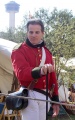 I had another experience, of learning to load and break down for cleaning, an authentic Colt Paterson revolver, so that I could write about that believably in one of my books. Another friend, a black-powder shooting enthusiast, let us go shooting at the range he has out in back of his house. (Which is waaaaaay out in the country, FYI.) Useful information for me, since the experience of shooting with a black-powder period revolver is as different from the modern Beretta that I had to learn to use in the Air Force. Out in California, I hung out in the weavers' barn at a little local museum, just picking up general knowledge about that process. And just this last weekend, out to Alamo Plaza to watch the San Antonio Living History Association events to commemorate the siege of 1836. I think the useful thing for me there was the clothes and accessories; all the difference in the world to eye-ball them close-up and in real time, rather than just look at pictures. Long live open-air historians; they are teaching other people besides me what the past looked like, felt like, and sounded like.
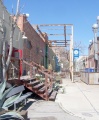 Blue Star and South Town
 Anyway, it's been a while, and the whole South Town and Blue Star scene is coming ever more close to being an art district. Think of it as a sort of Texas So-Ho/Tribeca, with repurposed industrial buildings and renovated cottages of a historical nature all mixed together along the banks of the lower San Antonio River in the shade of the Pioneer Flour Mill towers. After all, the area is wedged between historical downtown and equally historical King William, so why the heck not?
 We walked around for a bit, looking at an exhibit of prints and another of very modern art - which seemed to consist of random squiggly shapes cast or cut out of metal and hung on the wall, adorned with this, that or the other. Not my cuppa - but as my mother used to say, it obviously keeps the artist busy and amused. I'm still wondering about a series of twenty identical cast-iron leaf shapes, each with an identical trapezoidal divot of opaque cast glass inset into one edge. Hooo-kay, and yeah, I'm a philistine when it comes to modern art, as I suspect that much of it is a huge practical joke played upon the public.


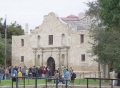 And that's what it was - a hundred and seventy-five years ago this spring - when the Alamo achieved fame immortal, just before sunrise in the spring of 1836. Visitors are usually taken back to discover that it is so small. I was, the first time I visited it as an AF trainee on town-pass in 1978; a little Spanish colonial style chapel, in limestone weathered to the color of dark ivory.
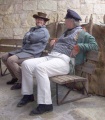 I have a full-sized copy of a birds-eye view map of San Antonio in 1873, which shows a grove of trees in rows behind the apse of the old chapel. In that year those surviving buildings served as an Army supply depot, and the plaza a marshalling yard. Did the Army supply sergeants or the laborers unloading the wagons ever wonder about the building they worked in. What did they think, piling up crates, barrels and boxes where a handful of survivors had made their last stand against the tide of Santa Anna's soldiers flooding over the crumbling walls? Probably not much- whitewash covers a lot.
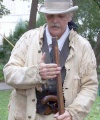 Those northern provinces of the nation of Mexico were in ferment in the 1830s, some of which might be chalked up to the presence of settlers who had come to Texas from the various United States looking for land. Many like Stephen Austin were honestly grateful for the free land and consideration from the Mexican authorities, and initially had no thought of trafficking in rebellion. But rebel they did; the old
 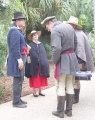 The rebels and their leaders chose to stand fast in the old mission, for reasons that they perhaps didn't articulate very well to themselves, save for in William Travis's immortal letters. James Bowie was deathly ill and David Crockett was new-come to the country, in search of adventure more than glory. None of them perfect heroes by any standard, then or now... but of such rough clay are legends made.
 I look out at my back and front yards - I assure you, it's a grim sight, indeed. I'd love to sign up for one of those television shows where they remake your entire front and back yard - landscape, hardscape, plantings, accessories and all. Starting all over by emptying all the pots and scraping everything else up with a bulldozer - including about six inches of topsoil - would feel pretty good to me at this point. There'd be something very satisfactory at starting all over again. Everything above the ground, and those potted plants that couldn't be sheltered in the house are as dry and crispy as the neighbor's lawns.
 In another three or four weeks, we'll be past the danger of frost here in South Texas. Maybe I will go out to some of my favorite plant nurseries then, and think about spring. I mean, by then it will be fairly obvious what is going to bounce back, and what has, metaphorically speaking, cashed in it's chips and gone to sing in the plant-choir invisible.

 If it's covered in fur or feathers, my daughter is immediately taken. She has one dog and a cat-a-log and by dint of saying "no!" in an increasingly firmer tone of voice I have kept the numbers down to a manageable level. Sammy, the three-legged, cross-eyed flame-point Siamese was full-grown, and belonged to some neighbors when he met and fell deeply in love with my daughter when she came home on leave. He took one look and fell in love, deeply, hopelessly, and abjectly in love. He parked himself in her lap, looked deep into her eyes, while purring like a distant motor-boat, and could hardly be pried away. When her leave ended, Sammy was heartbroken, although he kept returning to our back yard, looking for her. Some weeks later, he stopped appearing, and I finally heard that he had been struck by a car, as he was crossing the road. Sammy recovered, although one leg had nerve damage - he holds it up close to him and gimps around on three. The neighbors moved away, and we convinced them to leave Sammy to us - heck, he practically lived in our back yard anyway.
 Princess the tortoise-shell, was acquired at a neighborhood yard sale. She wasn't among the inventory, but she was at that devastatingly cute kitten stage, and the spitting image of Patch-cat, whom we adopted when my daughter was a toddler. Patchie stayed until she died from old age - sixteen years, three houses and four PCS moves later. So, Princess came home from the yard-sale; she is the one who loves to play with the jingly-ball cat-toys, skating them across the floor as if she were playing football against herself. Tristan also came as a kitten, a tiny and undernourished one. The daughter of another neighbor rescued a litter from being drowned and poor Tris was the runt that no one else wanted . . . except my daughter. She brought him home (Me: Another kitten!? Are you out of your mind?) He was bottle-fed for a good few weeks, in the hopes of remedying his pathetic runtiness. Tris, white below and brindle above, with jade-green eyes, is the talkative one. He will meow loudly in answer when we talk to him.
 And finally - Molly-Moo. Not a pathetic kitten, but a pathetic older cat; ten years old, de-clawed and anti-social. She came from a home which recently acquired a dog. Molly-Moo didn't get along with the dog. To be candid, she didn't get along with anyone else, either, and the previous owner was going to deposit her in the animal shelter. Where her chance of adoption stood at nil and none . . . so, my daughter rescued her from a death sentence. She is mellowing at this point - moved from hiding on top of a tall shelf, to hiding among the bed-pillows. And by virtue of offering frequent cat-treats, she no longer tries to bite us when we scratch around her ears.