Essential Dog
 My daughter's dog, better known as the Lesser Weevil, lives for walkies every day . . . and for a special treat, a trip to the McAlister Park Dog Park. She's a social creature, and rather outgoing; every human she has ever met has been instantly and utterly her bestest BFF. I do so hope that I would never have to depend upon the Weevil for personal protection in the case of a dangerous psychopath breaking into our house . . . since the Weevil will probably be cowering behind me. With other dogs, it's a matter of all things being more or less equal. A friendly and playful romp with a dog or dogs more or less of her same size and degree of playfulness; too much larger than her and a bit too aggressive with the sniffing brings on pretty much the same reaction as an encounter with a very much smaller dog afflicted with the canine version of a Napoleon complex. Why, why, why are the smallest dogs always the most combative, more prone to biting, more given - in vulgar vernacular - to write checks with their mouths that their posteriors can't possibly cash? I noticed this with a number of smaller dogs in the neighborhood, some of whom persist in getting stroppy with the Weevil, usually from behind a tall fence or at the end of a leash: it's as if they feel they have something to prove.
But none of this happens at San Antonio dog park; sometimes it seems that the more dogs are there, the better they are behaved, although sometimes I do worry about the smaller ones. Not because they are unleashing their inner urge to conquer Europe and invade Russia in winter . . . but because they run a distinct hazard of being knocked flying in a collision with a larger dog, intent on galloping across the dog park. Perhaps there might be some kind of justification for a "tiny dog" section of the park set aside, rather like a shallow "toddler pool" - for those that are under so many inches in height. For now, they all get along together . . . although when our pint-sized Shi-Tzu was still alive and accompanying us to the dog park, she didn't really seem interested in mixing it up with the other canines. She was pretty well glued to my ankles, tiny dog section or not.
 A visit to the park is always reassuring to us for another reason - there are always dogs that are larger than the Weevil. People whom we meet in our neighborhood often go on about her as if she is a large dog - when in actual comparison to really, really large dogs - she is really quite dainty. And when I say ‘large dog', I mean about the size of an Irish wolfhound, or a Great Dane, or even just the gangly young Doberman who was there last weekend - all legs and enormous feet and that brown-and-black shark-head which looks so terribly dangerous, until you realize that the dog is nothing but a great friendly doofus and the only danger that he poses is that of knocking you down, sitting on your chest and licking your face. Which happened to me with a young stray Rottweiler once, but that is another story.
 Another good thing about the dog park in McAlister Park is that the area around it has just been renovated and landscaped: a double row of sapling trees has just been planted on either side of the path from the parking lot (or is it really a ‘barking lot'?) and another double row of trees on either side of a new paved trail. The new trail leads down towards Salado Creek - a neighbor of ours went on a run a couple of months ago, and she says it is wonderful. When the trees are full-grown, it will be even more so.
Dog lovers may be interested to learn that dog loving organizations esists that are all about getting out and getting moving- for our dogs sakes as well as our own. San Antonio Nature Hounds is just one of many organizations that sponsors events such as training, hiking, camping, tubing, outdoors, picnic, patio dining, group walks or dog pack walks, nearly any day of the week at different locations. (All with their dogs.) Daily exercise is essential for dogs. A tired dog is a well behaved dog and well behaved dogs have happy owners.
 Having a weekend day free - and feeling a touch of cabin fever after four days of ice-cold-oh-my-heck-I-think-I'm-gonna-freeze-winter-weather (San Antonio style), the Daughter Unit and I felt a deep need to get up and get out someplace. Like to a movie - and what about (suggested the Daughter Unit, with a calculating look) seeing a movie at the Palladium! Yes, indeed - said the Daughter Unit with that expression of calculated pleading that she has perfected since she was about four years old - let's go see . . . The King's Speech at the Palladium! Eh - me, I'd have held out for the remake of True Grit, but seeing that practically everyone who had watched The Kings' Speech was singing hosannas of jubilant praise . . . why the heck not?
 Or - why having home insurance and careful - even pictorial documentation of the stuff inside your personal space is an excellent idea. The stuff in your house, the pictures on the wall, the clothes and kitchen things are just background; most of the time you only really notice them when they are missing.
 My parents had always lived in the back-country; they had a plan in place, in case of a brush fire like this one turned out to be. Sometimes, even just accepting the possibility of an event like this is halfway to having a viable plan. As it turned out, they had about twenty minutes warning - long enough for my father to snap some pictures of the fire as it approached, and to take more pictures of the inside of the house. My mother had time enough to load her car with a few bits of china, the strongbox with all their necessary documentation, her jewelry box and their pets.
 Well, it's not the wilderness, actually - but it would certainly look so to someone more used to living in the city. No streetlights, and the houses are set back from the roads - which are unpaved - and so a possessing good stock of flashlights and fresh batteries are something that every household out here needs, especially if planning to go somewhere and return after dark. I had to work the combination to the front gate by the light of my cell phone last week, so no - I won't forget a flashlight again. There may be starlight and moonlight on occasion, but underneath the trees, it's as black as the inside of a cow.
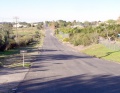 There was a lot of heavy rain over Christmas - which of course did a number on the dirt roads. For some strange, atavistic reason, my parents have always loved living on a dirt road, out in the hills. Possibly this cuts down the numbers of door-to-door evangelists and vacuum cleaner salespeople, but it's heck on automobile suspensions ... especially when a heavy rain has gouged huge gullies across the roadway, and what would have been the gutters on either side have become canyons capable of swallowing up Mini-Coopers.
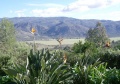 Birds are everywhere - humming-birds squeaking like rusty hinges, and quail rustling through the undergrowth. I see rabbits in the morning, when I walk down the hill for the newspapers: tan-colored, with a little white-cotton powderpuff for a tail. They lollop lazily out of the way, as if humans didn't frighten them very much at all. Probably they don't: dogs and coyotes must be more of a real danger to the rabbits.
 In a town near my parent's house there is a museum specializing in industrial and mechanical items, all housed in a range of barns and sheds. They have a huge collection of steam and gas-powered tractors and engines made to power threshers and harvesters ... all of those ingenious inventions which came about towards the end of the 19th century as an improvement on the brute muscle-power of horses or oxen or even humans. In a good many ways, we have become so accustomed to things powered by electricity, or various fuels that we take them for granted. Only when the power goes out, or when it becomes necessary to dig a hole with a shovel, do we have any clue about how much sheer physical labor it took to do things in the old way.
 So - when internet searches have only taken me so far, what better way than to consult with experts, re-enactors and hobbyists, those hands-on amateur scholars who explore such matters out of sheer love - and are most pleased to share their expertise. Like most things pre-industrial, transforming plant or animal fiber into garments turns out to have been labor intensive. Leaving alone the process of harvesting cotton or sheering sheep -and let's not even get into processing flax - it starts with combing or carding the cleaned fiber. That is done with a pair of square paddles set with short wire bristles, which straighten the fibers, pull them all into one direction, and remove some of the debris.