Condolences to Fort Hood
We wish to extend our condolences to the thousands of soldiers, civilians and family members who were touched by yesterday's tragedy at Fort Hood.
You’ll find our blog to be a wealth of information, covering everything from local market statistics and home values to community happenings. That’s because we care about the community and want to help you find your place in it. Please reach out if you have any questions at all. We’d love to talk with you!
We wish to extend our condolences to the thousands of soldiers, civilians and family members who were touched by yesterday's tragedy at Fort Hood.
 For Christmas, I would like for someone to give me a t-shirt that says “As a matter of fact I am not a $#@!ing tourist, I live here!” - but my daughter Blondie says that would be rather too hostile. And what brought that on? Oh, just the experience of going downtown at midweek, and having completed the necessary errand early, deciding to prowl the little art galleries and shops in La Villita, instead. La Villita is a collection of very old houses, very nearly the oldest in San Antonio, most of which were restored over the last thirty or forty years or so; electricity and plumbing being added to them with considerable difficulty. A good few have very low doorways, and very thick walls, and once were heated (if at all) with tiny fireplaces. The neighborhood is adjacent to the River Walk, and the Alamo - even if the shops and galleries offer merchandise a couple of cuts above the usual tourist tat, it remains that nearly everyone wandering through is in fact most usually…from out of town!
And since there weren’t many people wandering around, most of the vendors were a little bored and very friendly, well disposed to be helpful; really this part of the world is a very friendly place. If you are antisocial, you’d have to beat them off with a stick, but about the first thing anyone asked was So, where are you folks from? I just got tired of growling From here! Hence, the wish for the tee-shirt.
Blondie bought a silver and garnet ring from a small jewelry and art gallery, and admired a bronze cat statuette, one of an issue of fifty, by an artist who lives in Kerrville; she might very well go back and buy it next month. I fell in love with some paintings by another local artist, who does lovely impressionist Texas landscapes: great sweeps of meadow, or gently rolling hills - but above them the even bigger clouds, piling up in a clear blue sky. It looked like what I have seen out of the car windows on various road-trips towards the coast, so there was no surprise when the gallery manager said the artist lives in Victoria and paints the countryside thereabouts. Oh, yeah - when I’m a rich and famous writer, I want a couple of those!
Since I couldn’t afford anything, I derived amusement out of describing my ideal piece of Texas kitsch art: a huge painting of a field of bluebonnets, with some longhorn cows, standing knee-deep in them. In the background sits a windmill, and a tumbledown old barn with the Texas lone-star flag painted on the roof, and the clouds in the sky form the silhouette of the Alamo! Maybe even on black velvet, too! I’d have it somewhere where I could see people’s faces when they looked at it, and know that if they looked absolutely horrified, then they did know something about art. Alas, irony was taking a vacation somewhere away from La Villita; most of the people I described this vision to said that it sounded rather nice - Did I want to commission an artist, since all they had in stock along that line were painting of bluebonnets only.
Fall is here, it’s deliciously cool and the clouds are piling up – and some day, with luck, I’ll walk into that one gallery and buy one of the landscape cloud paintings.
 So, once the Halloween decorations were sorted out and put away, we could think of nothing better to do than to drive up to New Braunfels on Sunday morning to join in the Wurstfest 2009 celebration. What better place, and what better day is there to celebrate suds, sausage and song than in a small town, in a park by a cool green river, and on one of those gloriously cool autumn days? Music and revelry, carnival rides for the kids, and plentiful seating, under the pecan trees, or in the big and little tents, or the main hall.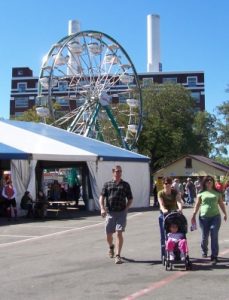
Wurstfest is one of those gloriously scrambled ethnic holidays that can only happen in the US – and possibly only in Texas. For sure, it might be the only place on earth where you can see a woman wearing a dirndl and cowboy boots, or have a serving of nachos and cheese with sauerkraut, while listening to an oompah band play the National Anthem, followed closely by the chicken dance. A huge beer stein in the main hall features – you guessed it, a painting chickens dancing.
 Besides the official leitmotif of sausages in every form – and there practically is every other variety of meat-onna-stick known to man available, the food vendors also have a wide range of fried stuff; regular fairground things like funnel cakes, but also deep-fried pickles and a delight which about made my arteries close up just to consider it; chicken-fried bacon. One of the vendors, the New Braunfels Smokehouse is well-established, but most of the other food vendors were run by local booster clubs and associations, like the Little League, the Canyon Lake Masonic Lodge, and the various Lions Clubs.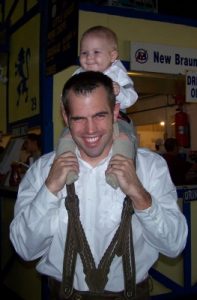
Of course – beer is the second official leitmotif, by the glass or the pitcher. New Braunfels was the second town established in the mid-19th century by a massive influx of German settlers brought over by a well-meaning, but ultimately disorganized group of nobly-born philanthropists. The Germans – those who survived the journey and the vicissitudes of the frontier – brought along an appreciation for arts, culture, and technology – and straightaway set to producing beer.
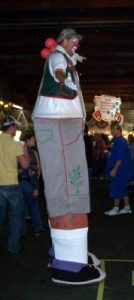 It is only fitting that one of the largest, if not the largest collections of beer bottles in the world is permanently housed on the Wurstfest grounds in the Spass Haus, which is either a museum cunningly disguised as a bar, or a bar cunningly disguised as a museum. In either case, no one dares begin to sing “9 hundred, 99 bottles of beer on the wall,” because they’d be there for at least the whole run of Wurstfest. The bottles are from all over the world; the oldest American beer bottles are from the 1840s.
And finally – it’s hats, some of them very strange; hats shaped like chickens seemed to be awfully popular, I spotted one shaped like a beer keg with a spigot on the side, another shaped like an over-flowing stein, (which really came from Germany, the wearer of it informed me) and the hat with a number of green tentacles on it also seemed pretty popular.
Wurstfest runs until Sunday, November 8th, not only at Landa Park, but throughout New Braunfels.
Key Points
October 31, 2009
AUSTIN – Gov. Rick Perry today sent a letter to U.S. Department of Homeland Security Secretary Janet Napolitano urging the federal government to stop its plans to transport illegal aliens from other states into Texas solely for the purpose of deportation. The Alien Transfer and Exit Program (ATEP), which is scheduled to begin tomorrow, would transport more than 34,000 illegal aliens per year through Presidio.
“Turning the Presidio area into a way station for the repatriation of illegal immigrants adds responsibility to local authorities and holds the potential of increasing the strain on local and state infrastructure and resources,” Gov. Perry said. “This plan will increase the likelihood that these individuals will immediately cross back into Texas, which is already bearing an uneven burden in dealing with immigration and border security issues along the Texas-Mexico border.”
Gov. Perry noted this program is a result of the federal government’s continued lack of an effective strategy for dealing with border security.
“Texas is proud of its working relationship with the United States Border Patrol, and we have invested significant state resources to assist them in their worthy efforts. We will continue to request that the federal government send the adequate resources necessary to effectively secure the southern border,” Gov. Perry said.
Since January, Gov. Perry has repeatedly urged the federal government, through letters to President Barack Obama, Homeland Security Secretary Janet Napolitano and Secretary of Defense Robert Gates, to approve his request for 1,000 Title 32 National Guardsmen to support civilian law enforcement efforts to enhance border security in Texas.
A porous border places Texas and the nation at risk from international terrorists, organized crime cartels and transnational gangs. Until the federal government fulfills its responsibility of securing our border, Texas will continue filling in the gaps by putting more boots on the ground, providing increased law enforcement resources and leveraging technology along the border.
In the absence of adequate federal resources to secure the state’s southern border, Gov. Perry recently announced the state’s latest border security enhancement using highly-skilled Ranger Reconnaissance (Ranger Recon) Teams to address the ever evolving threat along the Texas-Mexico border. Additionally, under the governor’s leadership and thanks to action taken by the Legislature, the state has dedicated more than $110 million to border security efforts in each of the last two legislative sessions.
To view the governor’s letter to Secretary Napolitano:
Attached File: Gov. Perry's Letter to Secretary Napolitano
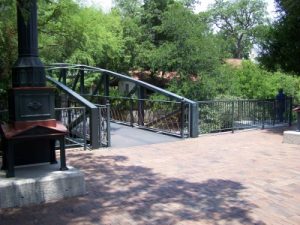 The river was always there, one of those which fan through Texas, draining the high plains, running down through the limestone hills, and the coastal plain before draining out into the Gulf. None of the rivers - the Nueces, the Brazos, the Colorado, the Guadalupe, even the River Grand, which now forms the border between Mexico and it's one-time territorial possession - are deep enough to have been navigatable for more than a little distance. Their valuable service to settlers was in providing a reliable water source, rather than a river-highway into the interior.
And the presence of the river, and the San Pedro Spring (which once burst up out of the ground, gushing like a fountain with considerable force) was one of the reasons that the Spanish established a mission and a sketchily manned presidio, early in the 18th century, which establishments shifted positions very slightly over ten or twenty years, until everyone was more or less content with the arrangement of the string of missions along the river, the presidio, and the acequia - the water-distribution system, which fed the cultivated fields.
Over the next century, as San Antonio grew and morphed from an outpost of Colonial Spain, the river continued to be important to the people who lived along it's banks. In the mid-19th century, Frederick Law Olmstead (who would eventually contribute a bit of key city-scaping - that of Central Park - to New York City) observed that all the nicest houses in San Antonio had gardens that backed on the river, and swimming and bathing in it was a very popular diversion.
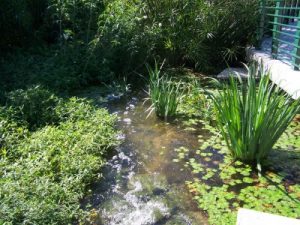 Having been founded because of water, water became an integral part of San Antonio - but now and again, as with all good things, there was just too darned much of it. A disastrous flood in 1921, which drowned fifty people, made it perfectly clear that "Something Ought To Be Done." The initial plan called for a dam, upstream in Olmos Park, and a bypass channel to route excess water away from downtown. The plan also called for paving over the bend in the San Antonio River between Houston Street and the Villita Parkway, using it basically as an underground storm-drain - but that was where the San Antonio Conservation Society took exception. Wrangling over what to do continued throughout the rest of the decade, while a local architect named Robert Hugman worked up a beautification scheme, calling for walkways at river-level, ornamental bridges landscaping. Hugman wanted to call his development "The Shops of Aragon and Romula" which doesn't have quite the same ring and brevity of "The Riverwalk" - but he believed in it to the point of keeping his own office in the area.
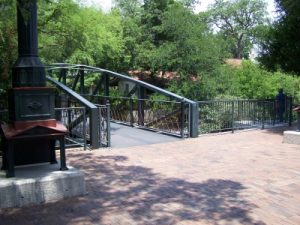 In 1939, funding became available through the WPA, for the initial 17,000 feet of walkways, some twenty bridges and a number of ornamental plantings, and fountains. In the mid-40's the Casa Rio restaurant opened. HemisFair, in 1968 added another significant length to the original; eventually there would be eight major hotels, one shopping mall, and the original Casa Rio would face competition from more than fifty restaurants, star-scattered the length of the meandering landscaped promenade. The Riverwalk has been expanding ever since, by fits and starts in either direction, north and south, as residents and tourists discover - or rediscover - the joys of living on the river. Long-term plans call for extending the Riverwalk - with bike trails, meadows and stands of native plants, another thirteen miles or so, all the way south, to link up with the original Spanish missions. Indeed, San Antonio lives by the river, in more ways than the early Spanish settlers could ever have known.
|
White House Staff Select Blue Room Christmas Tree FOR IMMEDIATE RELEASE |
|
Chesterfield, MO (October 20, 2009) -- A beautiful Douglas-fir from Shepherdstown, W.V., will be the official White House Christmas Tree this year. The Blue Room Christmas Tree will be officially presented to First Lady Michelle Obama by Christmas Tree growers Eric and Gloria Sundback. The Sundbacks earned this honor by winning the National Christmas Tree Association's (NCTA) national Christmas Tree contest held in August 2009 in Chattanooga, Tenn., and becoming Grand Champion. The Blue Room Christmas Tree was handpicked by Director of the Executive Residence and White House Chief Usher Stephen Rochon and Superintendent of Grounds Dale Haney on Oct. 20, 2009. The tree, which was planted by the Sundbacks in 1996, will be cut in late November and sent to Washington, D.C. Eric and Gloria are no strangers to the White House Christmas experience. This will be the fourth time that the couple has won the contest and presented a tree to the First Lady. “It is always an exciting time and it is interesting to meet all the First Ladies,” Gloria says. The couple first began growing Christmas Trees in 1956 in western Pennsylvania. In 1959, Eric’s work as a landscape architect took them to the Washington, D.C., area where they began a search for land to continue their Christmas Tree farming on the best soil possible, settling near Shepherdstown, W.V. In 1967, Eric and Gloria started retail lots in Bethesda, Md. and Washington, D.C., which they operated for 40 years before passing the retail side of their business to two veteran employees. Both in their 80s, Eric and Gloria continue development of the seed orchard part of their farm. The presentation to the White House is tentatively scheduled to take place on Nov. 27, 2009. The tree will be set up in the Blue Room later that day, where the White House Floral Department staff and volunteers will decorate it. Members of the National Christmas Tree Association have presented the official White House Christmas Tree for display in the Blue Room since 1966. For Real Christmas Tree selection and care #### For More Information: |
 The Magik Children's Theatre's curtain opens to Room 207 at an elementary school, where the rowdiest, loudest, rudest and most misbehaved students are paying no attention to their teacher, Miss Nelson. She is a sweet, kind, soft-spoken educator. She asks her students to "please calm down" so she can read them a story. When her pupils stand on their desks, run around the classroom and throw rulers, Miss Nelson's blood pressure reaches its limit, and she runs into the principal's office for shelter from her educational nightmare..
Meanwhile, my three companions, Olivia, 8, her sister, Noelle, 6, and their mother Brandy wait to see what happens next. Olivia and Noelle sit on their knees, resting their chins and arms on the seats in front of them, trying to get closer to the stage. Their eyes are stuck on the classroom mayhem.
With Miss Nelson gone, the classroom door opens for the substitute teacher, Viola Swamp. She is a piece of work. Her crooked nose and protruding chin are covered with a smatter of warts. She's tough and strict. She yells, calling the class to order by loudly rapping her black baton on the desks. The students and audience jump to attention. Who is this ugly creature? Her pupils sit quietly, knowing she won't put up with bad behavior.
Swamp drills the class on their schoolwork, roundly bawls out the know-nothings, slams her baton on their desks again and again and assigns heavy overnight homework that would buckle the best of students. The audience breathes more easily when intermission begins.
A stagehand and one of the naughty students wearing a glow-in-the-dark, bright orange wig push the stage set 180 degrees on its circular track. Now instead of a classroom, we see the front of Miss Nelson's prim cottage. In the theater lobby, children juggle ice cream sundaes, popcorn and wrapped birthday presents for two honorees.
Back on stage at Miss Nelson's home, the once-misbehaved students try to find her before it's too late. They ask each other whether they will ever see their sweet teacher again. My friends, Olivia and Noelle, whisper between themselves as they wonder what happened to Miss Nelson. Her students dance and sing in front of her cottage, but "Miss Nelson Is Missing" (the play's title).
The story ends happily. The audience is taught an important lesson in classroom behavior. The show is over in about 50 minutes -- just long enough for youthful attention spans. Olivia and Noelle say they had a great time.
"Miss Nelson Is Missing" continues through Nov. 7, 2009. The theater is located at 420 S. Alamo St. in Hemisfair Park. Showtimes are Tuesday through Friday, 9:45 a.m. and 11:30 a.m., Friday at 7 p.m., Saturday and Sunday at 2 p.m. Tickets are $10 for adults and children. Phone: (210) 227-2751. No one is turned away because of an inability to buy tickets. The actors are paid employees.
 The play is based on a book by Harry Allard and adapted for stage by Joan Cushing. Becky King is the local director and choreographer. The Magik Children's Theatre encourages literacy by producing only plays based on books children are reading in school. The theater, which opened in 1994, seats 600 people.
**Magik Theatre Miss Nelson Photos© 2009 David Frank_ArtGives
The Majik Theatre is located just across from The Fairmount Hotel at Hemisfair Park.
A benefit for the Heart of Texas Labrador Dog Rescue (HOTLR)will be held at The Faimount Hotel. (An Evening of Giving, Texas Style. November 7, 2009 from 5-9pm.)
Join us in a modern day treasure hunt in Texas State Parks
WHAT IS GEOCACHING?
Geocaching is a type of treasure hunt using a GPS unit to help you find hidden "caches" placed by people all over the world. Geocaches are everywhere - from just down the street from your house to the most remote wilderness areas. They range from extremely small containers (35-mm film canister or smaller) to large ammo-style boxes.
TEXAS STATE PARKS GEOCACHE CHALLENGE
We invite you and your family to join us in discovering hidden items while revealing exciting facts and stories about Texas State Parks. All you'll need is a GPS (Global Positioning Satellite) unit, the coordinates for the hidden treasure (or caches), and a Texas State Park Geocache Challenge Passport Book available at participating state parks or by downloading it here.
We have hidden a special geocache in each of 12 state parks for you to find. In each cache, you will find a logbook that describes a special feature of the park that you can use to answer a question in your Geocache Challenge Passport Book. Also, there will be a special orienteering punch that you will use to mark your Passport Book to claim the cache, and a logbook to sign. You may also want to log your find on www.geocaching.com
The cache should contain small prizes and trinkets left by TPWD staff and fellow cachers. If you take something, be sure to leave something of equal value so cachers who follow you will have something to trade.
We will post the GPS coordinates (or waypoints) on this site Nov 1st at noon. Enter the waypoint into your GPS unit manually, or download it directly from the site www.geocaching.com.
Once you have found all 12 caches, send your completed Passport Book to:
Texas Geocache Challenge - TPWD
944 Highway 71 East
Bastrop, TX 78602
The first 100 returned passports receive a commemorative Texas Geocache Challenge coin. Other gifts will include large stickers and a certificate of completion. So, get out there and find those caches in your state parks, and discover how life's better outside!
Participating State Parks: (map)
Don't know how to Geocache? We have special workshops hosted at our State parks to introduce you to this activity. http://www.tpwd.state.tx.us/newsmedia/calendar/?calpage=a0213
ITEMS TO BRING ALONG Geocaching is a great way to enjoy your state parks. As with any outdoor activity, it helps to have some special items to make your adventure more enjoyable and safe. We suggest the following items when geocaching:
Pilot Effort Will Test Way To Get People From "Online" to "Outside"
Oct. 28, 2009
AUSTIN, Texas — A new program at 12 Texas state parks aims to use technology to draw visitors into the outdoors. The Texas Geocache Challenge will run from Nov. 1 through Jan. 31, 2010, challenging state park visitors to use Global Positioning System technology to find a cache of hidden rewards in each park.
Participating central and southeast central parks are Bastrop, Buescher, Government Canyon, Guadalupe River, Huntsville, Lake Somerville-Birch Creek, Lake Somerville-Nails Creek, Lockhart, McKinney Falls, Monument Hill-Kreische Brewery, Palmetto and Washington-on-the-Brazos.
"It’s a good, healthy way to get out on the trails of state parks," said Chris Holmes, outdoor education coordinator for Texas State Parks. "We think it will be appealing to families, a really fun thing to do in a state park. The fun thing with the kids is that they literally get to find treasure, so we know they will be excited when they find the cache."
"Children today are very different from children of the past," Holmes explained. "They are much more technology-savvy, and our experience at park workshops for families has shown that the kids end up leading GPS activities. This is really using technology to be outside."
Participants can download a Texas Geocache Passport, as well as the coordinates of each of the caches, from the TPWD Web site. In each of the 12 parks a hidden box will contain small prizes, information about the park, a logbook for cachers to record their visit, and a paper punch unique to the park. Geocachers can use their GPS units to find the containers and then use the punch to mark their passports to verify their visit.
When geocachers have found all 12 boxes, they can mail the passport to TPWD, and the first 100 people to send in their passports will receive a commemorative geocoin. Other participants who finish will qualify for other prizes, such as a map of all 12 parks, Texas Geocache Challenge stickers and a certificate of completion.
The department also is making a low-tech version of the challenge available for visitors who don’t own a GPS device. Outdoor sleuths can download written clues to each of the hidden caches from the TPWD Web site. The department also is working on a Facebook page and a Twitter feed to accompany the challenge, which will allow participants to post photos and descriptions of their adventures.
"We really want people to get outside, and this is another reason for people to go out to state parks, Holmes said. "It’ll be a three-month pilot, and then we are going to evaluate it, and if it’s as successful as we expect, it could go statewide within a year."
Media Contact: Tom Harvey, 512-389-4453, tom.harvey@tpwd.state.tx.us; or Chris Holmes, 979.229.2886, chris.holmes@tpwd.state.tx.us
———
On the Net:
The good thing about San Antonio being so far inland is that - well, those hurricanes which hit the Texas Gulf coast are usually pretty well diminished to a stiff breeze and a lot of rain by the time they hit San Antonio. The bad thing about being so far inland - is that it takes a good three hours or so to reach the coast. The good thing about that is - it's a very scenic drive, either on IH-37 South, or if you hopscotch all across all of south Texas on secondary roads. No matter if the route takes you from Floresville to Kenedy, to Goliad and Refugio and points south- to Port Lavaca, Rockport or Corpus Christi, or anywhere else along the Texas Gulf Coast - it's all a good and scenic drive, meandering through gently-rolling green hills, threaded with steep-banked creeks and small rivers, which gradually flatten out and then give way to salt-marshes and bayous grown with rank after rank of tall reeds and bamboo thickets. The Texas Coast fishing isn't bad either.
And at the end of several hours on the road - there is the open sea, beckoning. Not that there is much spectacular when you eventually do get there. The Texas Gulf Coast doesn't have sugar-white sand beaches like Hawaii, or red-wood shrouded cliffs like California's Big Sur, but it's wet and salty and will do very, very well for us - even if it means another two or three hours, driving back home lightly sun-burnt and with scratchy sand working its way between your skin and your damp bathing-suit. A water park, no matter how lavish, just doesn't have the same zing, the same salt-smell, the same view of sailboat masts bobbing up and down in the marina, or the great hulk of an aircraft carrier halfway between shore and the horizon. The sunset doesn't paint it all with the same golden-apricot glow.
And although San Antonio does have a Seaworld ... there isn't quite the same air about it, stranded so far from the ocean, the I-don't-know-what-the-expression-for-it-is that an aquarium on the seafront does, an aquarium like the Texas State Aquarium in Corpus Christi. There is a sense of rightness about a sea-front aquarium, when you are barely a stone-throw from the world underwater. The aquarium in Corpus Christi shelters over three hundred different species of aquatic animals. Reptiles, amphibians, fish and other sea creatures are on display in specially designed habitats, habitats that mimic the natural world as precisely as possible. Visitors can get as close as a whisper, to creatures they would most likely never encounter - or want to encounter, in the wild. Floating jellyfish, stingrays, dolphins and otters - every day, from nine to five. And they have their eye - if they have eyes - that is, just as you watch them.