Luring the CAT to Central Texas
Local Government Tools that Made The Difference
- Local property tax abatement (Chapter 312, Texas Tax Code) - no city or county tax bill for 10 years.
- Value limitation and tax credits (Chapter 313, Texas Tax Code) - Eight-year limitation on the value assessed for school district maintenance and operation tax and two-year eligibility for tax credits. (No limitation on interest and sinking tax assessment.)
- Freeport exemption from personal property tax on parts and materials exported within 175 days of delivery to manufacturing facility.
- Economic development sales tax - Incentive funds allocated by 4A corporation.
Incentives for CaterpillarLocal
- City of Seguin -100 percent property tax abatement for 10 years.
- Guadalupe County -100 percent property tax abatement for 10 years
- Seguin ISD - Available $80 M value limitation per year on appraised property value for maintence and operations plus hold harmless funding from the state of Texas.
- Freeport exemption on personal property tax in Seguin, Guadalupe County, Seguin ISD.
- Seguin Economic Development Corp. - $2M incentive: $1M cash; $1M bond for sewer, road infrastructure.
- Regional partners offering incentives include: Guadalupe Valley Electric Cooperative, Center Point Energy and Springs Hill Water Supply Corp.
State
- Texas Enterprise Fund - $10M.
- Texas Department of Transportation - Deceleration lane, traffic signal - $450,000-$500,000 est.
Luring the CAT to Central Texasby Gerard MacCrossan Construction under way as Chapter 313 change paves way for incentive application Enticements that local economic development officials estimate could total about $80 million during the next 10 years, proximity to transportation and even the mild winter weather were factors prompting Caterpillar's anticipated roll into Texas. The heavy equipment giant is relocating one of its primary global engine assembly, test and paint operations to Guadalupe County, about 30 miles northeast of downtown San Antonio. Texas won the investment and 1,465 projected jobs over sites in Mexico and South Carolina. Caterpillar plans to have a $170 million facility close to Interstate 10 manufacturing engines by mid-2010 and fully operational in 2011. Seguin Economic Development Director Terry Treviño estimates the local incentive package, which includes $10 million from the Texas Enterprise Fund, could save Caterpillar $70 million during the next decade. The rest of the package includes city and county property tax abatements under Chapter 312 of the Texas Tax Code, freeport exemption on parts and materials used in manufacturing that stay in Texas for no more than 175 days, and reduced school taxes Caterpillar is seeking under Chapter 313 of the Texas Tax Code limiting the appraised value of taxable property. Construction work is under way at the plant and Caterpillar's Chapter 313 application - the last piece of the incentive puzzle awaiting approval - was filed with the Seguin Independent School District in July after the 2009 Texas Legislature modified the incentives' qualifications. The change allows a company to qualify for Chapter 313 tax abatements if it hires more than 1,000 workers earning 110 percent of the average county wage. Caterpillar announced its work force's average wage will be $21 per hour, which is higher than the average manufacturing wage in Guadalupe County, but not 110 percent - the level needed to qualify under the previous Chapter 313 rules. State Rep. Edmund Kuempel of Seguin, who introduced the amendment modifying Chapter 313, says legislators knew the change was beneficial not just for Caterpillar and Seguin, but the whole region and state. "It is a big boost for towns and counties within 30 or 40 miles, not just with Caterpillar, but the suppliers, too," he says. "The work force could grow to 3,500 or 4,000 people with the work force at Caterpillar and the companies servicing it." Although most of the incentives will be provided by Guadalupe County and Seguin entities, surrounding communities, such as New Braunfels, Marion, Schertz and Wilson and Gonzales counties, also will benefit from wages paid to commuting workers and new companies moving in, Kuempel says. "Seguin is a prime location that brings Cat closer to our supplier base and customers," says Caterpillar spokeswoman Kate Kenny. "Seventy percent of the products manufactured in Seguin will be exported and this location provides excellent access to ports and other key logistical opportunities. "State and local officials worked very quickly and aggressively to meet our needs and deadlines to make this a reality," Kenny says. "We value teamwork and this was a true team effort." "It is a big boost for towns and counties within 30 or 40 miles, not just with Caterpillar, but the suppliers, too." - State Rep. Edmund Kuempel According to Treviño, the city's and county's similar Chapter 312 tools already in place streamlined the process for offering the 100-percent, 10-year property tax abatement. Seguin ISD's Chief Financial Officer Sandra Hill says Caterpillar has applied for the appraised value limitation, which would apply to the maintenance and operation portion of the school tax bill; the ISD's debt service tax would be levied at the total appraised value. The Seguin EDC kicked in $2 million backed by 4A sales tax receipts - $1 million in cash and a further $1 million to fund sewer and public road improvements around the Caterpillar site. The EDC's investment is substantial considering the annual 4A receipts are about $800,000, according to Treviño. However, Seguin EDC had funds in the bank, thanks to reserves generated from previous real estate investments, and last summer paid off all its debt prior to agreeing to sell the new Caterpillar bonds. It wasn't just financial commitments that swung the Caterpillar deal. Seguin city leaders committed in early December - before the deal was formally announced - to expanding wastewater collection capacity at the site, which lies on the northeastern outskirts of Guadalupe's county seat. The Texas Department of Transportation offered two new turn signals and a deceleration lane for truck traffic entering the plant. Spokeswoman Helen Havelka says preliminary cost estimates for the TxDOT work - all on public right-of-way - is $450,000 to $500,000. Part of the state funds committed will go to work force training, Treviño says. Adding 1,465 employees - making Caterpillar the community's largest employer - shouldn't be very difficult given 25,000-population Seguin's proximity to northern San Antonio and its bedroom communities in western Guadalupe County, as well as New Braunfels and San Marcos. "We're one of the largest manufacturing cities in the state of Texas," Treviño says. "The work force is skilled." Training would be delivered by the Alamo Community College District, almost certainly at the Central Texas Technology Center - a collaboration with Seguin and New Braunfels economic development officials located adjacent to the New Braunfels Airport in northwestern Guadalupe County. TR |
 I took a break from it all last weekend, and hit the highway - in support of a spasm of marketing for the
  . Months ago I had been invited to participate in a cultural festival at the Fort Bend Museum in Richmond. It was the first long road-trip in a while, if three hours on IH-10 East, almost-but-not-quite to Houston counts as a road trip. I have to say that the passing scenery was not particularly spectacular, but oh, my - the rest stops are absolutely palatial. I couldn't resist taking a picture of this one, just about an hour's drive out from San Antonio.
 That part of East Texas is subtly different from the area around
 Enough remains of the town to show what it once was like, anchored by the railway and a bend of the Brazos, adorned with stately, white-pillared homes, rambling Victorian cottages trimmed with yards of wooden gingerbread trim, and dignified old two-storey commercial blocks on the main street. Here and there, this pleasing 19th century aspect is broken up with indigestible chunks of Brutal Concrete Moderne, but it's easy enough to look away from those.
 I was directed towards the very best place to eat; for soups, sandwiches and salads, nothing better than Sandy McGee's on Morton Street, situated in a 19th century storefront block which my hosts insisted was haunted. It might very well be - or it might just be someone coming back from the afterlife for a slab of cheesecake.
 There were a lot of Texas historical connections in Richmond. Jane Long - the widow of one early pioneer/adventurer lived there for many years, as did Carrie Nation, she of the saloon-smashing temperance brigade. So did Mirabeau Lamar, sometime president of the Republic of Texas, who fought with Sam Houston like two tomcats in a sack. Sam Houston's master of scouts, Erastus "Deaf" Smith is also buried there - ostensibly on the Fort Bend Museum grounds, but possibly underneath the nearby street intersection. Benjamin Franklin Terry, of
  When in the name of all that's unholy, did Halloween turn into an extravaganza of coffins and mock gravestones set up in suburban lawns, and formations of witches plastered onto tree trunks and garage doors, great glowing hanging jack o lanterns, and ghosts and witches and skeletons and huge ass spiders (shudder!) and monstrous webs, and life-sized skeletons? When did decorating the house for the benefit of small children in dime-store costumes or something cobbled together from a stack of torn bedsheets and some Rit dye, panhandling door to door for packets of candy corn and little pastel rolls of sweettarts go so very, very far over the top as - a full Griswald Christmas? It probably happened about the same time that the pattern catalogue for costumes at the yardage store became as thick as a seasonal catalogue and stayed on the yardage store pattern table year around. But it must be fun, since so many
  Back in the day, it used to be an innocent, home-made, modest little affair. Mom bought us each a pumpkin, and in the early days Dad helped us carve them with a kitchen knife and scrape out the mooshy tangle of seeds and stringy orange fibers. By the time my brother and I were in junior high, we conducted the ritual pumpkin butchery ourselves, and assisted our younger sister with marking out a scary face in straight-angled cuts. Fit the pumpkins with candle-ends, saved for this purpose in the drawer with the silverware, set them out on the front porch, and there we were, all set. Of all the neighbors in the town where I grew up, only one got ambitious, rigging a ghost of cheesecloth to fly silently down a wire running from the trees by their gate to just above the front door.
 Close to sundown, we would light the candles in the pumpkins- it was really, truly only tricker-treating, after it was at least decently dark, with smothered giggles coming from the front porch, and children in twos and threes working up their nerve to ring a strange doorbell. Usually, there was a parent or older sib outside the circle of porch-light, cuing the chorus of "Tricker-treat!" and reminders to say "Thank-you!" before they romped away, clutching their brown-paper grocery bags of treats. That hasn't changed, nor has the creation of slightly more elaborate Halloween parties, and haunted houses, such as the venerable
  Home-made, kid-made costumes, simple pumpkins, and brown-paper bags- all very simple in comparison, as shapeless and disorganized as a scratch softball game on an empty lot on a summer morning when school is out. Now that Halloween is all elaborate, and organized, like Little League, with uniforms and coaches and formal rules, it may be more spectacular, but I have a sneaking suspicion it may have been more pure fun for the kids then.
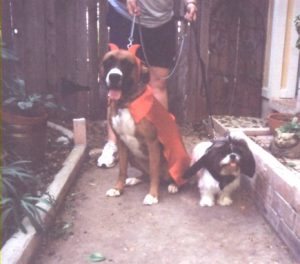 There is a dog park, hidden away in the back forty of
  One of our neighbors told us about the park; admittedly, we were nervous about the whole off-the-leash concept with regard to the Lesser Weevil. We have no apprehensions about the Weevil and humans - it's other dogs. Now and again in the early months, she took an instant and abiding dislike to another dog on a leash. But our neighbor assured us, over and over - that it is all right, the dogs seem to govern themselves very well, off leash, and the more there are of them in the confines of the park, the better they all behave. So we took a chance - and we stuck very close to her that first time, and waited until she had behaved well with the first half-dozen dogs that came romping up for a bit of friendly butt-sniffing.
 Weevil still does not play as uninhibitedly with the other dogs as others do. She'll chase a thrown tennis ball and run races, but she will stay fairly close to Blondie. And Spike the Shi Tzu basically attaches herself to my ankles, never going much farther than ten feet away, even if there are other small dogs who want to play with her. It was quite lively this last Sunday; not least because it seemed to be Big Dog Day. Sometimes people tell us that the Weevil is a big dog; no, she actually is rather agreeably medium-sized. On Sunday she looked positively dainty, next to a Newfoundland the size of a small sofa, two mastiffs who topped out at a couple of hundred pounds each, and a Great Dane who looked big enough to put a saddle on and ride like a horse. No kidding, the Great Dane's nose alone was bigger than the smallest dog present - a four-month-old Chihuahua puppy, too small to be put down on the ground, among all those specimens of canine gigantism.
 And of course, the Weevil behaved herself - how could she not, when the whole place was seething with dogs; dogs running, chasing tennis balls and each others' behinds, begging to be played with and petted, and romping in front of, or behind their people making a slow circuit of the path around the park? No, it was a good day and good for her - and kind of a relief to know that Blondie has trained her to obedience well enough to trust her off the leash and with a large number of other dogs.
 My friend Jim and his son Scott are still talking about
  Jim said, "They are very mean. They'll chase you. If you shoot one and don't get it dead, you better watch out because he's going to come get you."
 Later in the day Jim shot the group's first hog with his rifle. The animal weighed 214 pounds, the heaviest hog taken during the four-day hunt.
 "Everybody said I about broke my arm patting myself on the back."
 Whenever my daughter and I have a need to go downtown in the morning, we like to go for lunch at the Guenther House - an old San Antonio mansion converted to a restaurant, museum and retail outlet, in the middle of a pleasant green garden a little way south of downtown San Antonio. The Guenther House was originally built by a C.H. Guenther, a German immigrant who relocated from the Hill Country, and established a mill on the
  He built the house for his family right next to his mill - and there it still is, the
  Afterwards, my daughter decided we ought to walk off the very good sandwich lunch, by looking at the old houses along
  There are other metaphorical old friends, along this street: This is the
  Although it is a historical district, not all the houses are quite so well kept: some are a little battered, a little overgrown, and broken up into several units. Keeping them together and air-conditioned in the summer must be a veritable money-pit.