A Walk in the Gardens
 I am now convinced that every large to medium-sized American city which possesses some history and a fair amount of local wealth, also possesses a botanical garden housed in a once-magnificent gated estate with a marvelous garden; San Antonio's McNay Art Museum, for example - an old-family-estates-with-landscaped-grounds-now open for all to appreciate.
 As a child growing up in suburban Southern California, my mother frequently took us to several such - Descanso Gardens, on the grounds of newspaper magnate Manchester Boddy's estate, the Los Angeles County Arboretum, which was once part of E.J. "Lucky" Baldwin's Santa Anita ranch, and the Huntington Library and Gardens, once the property of railway magnate Henry Huntingdon. (Mom had a weakness for extensive rose gardens, and also for dropping the three of us off for special kiddy summer education programs at Descanso. We just liked to feed the ducks, and explore the camellia wood.)
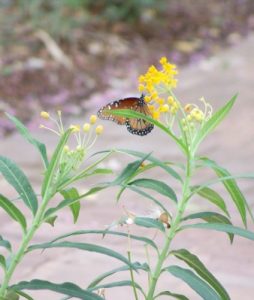 So, in wandering around the San Antonio Botanical Garden, I was quite surprised to discover that it was not, in fact, a relic of such an old estate, left in trust to the municipality by a public-spirited heir of a 19th century entrepreneur. The Botanical Garden was in fact only designed, constructed and planted over the last thirty to forty years in an old quarry and city waterworks, at what was once the far northern part of San Antonio and west of Fort Sam.
 Amazing, actually - how speedily trees planted to fill in between whatever native oaks there may have been - have grown and adapted. From the general look of things, and from the age of the suburbs surrounding it, I would have guessed that garden must have been established long before 1970-1980. The area around Mahnke Park and North New Braunfels is stiff with 1920s Craftsman-style bungalows and rather charming Spanish Colonial Revival villas, all plaster and rust-red tile roofs. Within the garden itself, though, there are a couple of building relics of relatively greater age, like the Sullivan Carriage House and the Auld House, a Hill Country log cabin from the 1880s, which have been painstakingly removed from their original locations and established within the garden, among suitable plantings. And there are wonderful 360 degree views from the lookout pavilion, at the highest point of the garden - all the way to downtown San Antonio, actually.
 Of the specialty gardens, my daughter and I appreciated the sensory garden - a series of outdoor rooms, with many raised beds and trimmings of statuary - such as an armadillo, and an enchanted castle in pottery. The Japanese garden will be splendid in the fall, though, when all the maples are in color. (Note to self- schedule a return trip in September or so . . .) And of course, the most wonderful thing about a garden like this is - that no matter how many people are there, the place is so large, and so carefully designed that it still offers a feeling of solitude, walking slowly between the trees and under the arbor.


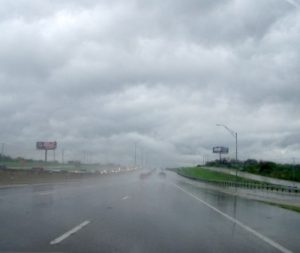 Storms blew in again into San Antonio tonight, bringing welcome rain, something which - with luck - happens least once a month during a normal spring and summer. Thunderstorms in South Texas are as outsized as everything else is supposed to be in the west. Sometimes they appear as great creamy mounds of cloud, piling up and up and up in the clear blue sky, the bottom layer as flat and grey as a an iron, pressing down on the land.
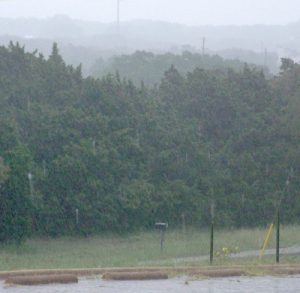 Storms that come in at night introduce themselves with lightening; one spectacular storm a couple of summers ago lit up the sky constantly for half an hour; nonstop flickering light, etching the trees and tall landmarks in harsh, blue white light; impossible to count the seconds between the flash and the noise, while gusts of wind lash the tree branches.
 Ten, fifteen, twenty minutes, the downpour is relentless, but then it seems like it is not so dark, the twilight is lifting, and the roar on the patio roof dies away. A few birds chirp uncertainly from where they have taken shelter. A crack of blue sky widens between two clouds, a fan of sunbeams spreads open like the halo of a saint in an El Greco painting, and the storm is gone as swiftly as it arrived. And with luck, there'll be another one in a couple of weeks, so I'll not need to water my garden with the hose, and the
  We use water around our homes to cook and clean, bathe and shower, wash our hands, flush the toilets, wash the cars, water the
  If you have a dripping faucet, try to turn the faucet to stop the drip. You shouldn't have to torque the handle of the faucet to make the leak stop. If you have to over tighten the faucet handle or can't stop the faucet from dripping, you've identified atleast one problem. Replacing the washers or the complete faucet set is not too difficult a task for most do-it-yourselfers. Home improvement and your old fashioned neighborhood hardware stores have very helpful people. If you aren't up to tackling the repair, you may have to hire a plumber.
 While still not using any water inside the house or from the outside faucets, walk to the water meter and check to see if the meter is moving. My low flow indicator appears as small blue triangle that spins when small amounts of water is flowing through the meter. (See the picture, the small blue triangle between "25" and the red pointer.) If the small triangle or the red pointer is spinning, water is passing through the meter and you may have a leak somewhere. (The red pointer movement indicates a lot of water is flowing.) Beware that your ice-maker or water softener may activate automatically while you are watching your meter for leaks. Observe the meter readings over several minutes to a couple of hours to more accurately detect any leakage.
 Well, the Daughter Unit and I made a most excellent discovery, returning home last weekend with a trunk full of finds at the
  Still, although sufficient for current needs, the market itself wasn't quite up to the weekly street market that I used to frequent when I lived in Greece - there, it was three blocks of a suburban street blocked off and two lines of little booths and tables, and the backs of trucks - but still, we're getting there. Everything fresh as fresh can be, seasonal and local - and who can quarrel with that?
 And I want to experiment with making home-made mustang grape jelly - and lo and behold, one of the venders even has a source for mustang grapes. Really, it couldn't get much better than this.


 My Daughter Unit is currently a college student, busily engaged in picking up credits towards a degree in research biology, and therefore is on a strict budget as far as recreational shopping goes. Still, she enjoys the thrill of the chase, and the flush of victory at finding and locating the perfect object of desire for mere pennies on the dollar. Seriously, it's much more fun, and feels like much more of an accomplishment finding a lovely, unique and tasteful accessory, item of clothing, or whatever - for practically nothing at all. Buying something at full retail now feels like . . . well, not that much fun at all. There's no challenge, it's all too easy, and the penny-pinching Puritan within us also murmurs disapprovingly about what a waste of money that is. And being a
  We're not above checking out what's been put by the curb for semi-annual trash-pick up, either. We live in hope that some day, something that we picked up for pennies will turn out to be an
  Last Saturday was the day of the
  As rummage sales and


 In the Botanical Garden that is - the
  Of course, the first playhouse was more or less just that - not much different from the little wooden house with two unglazed windows that my brother and sister had as children - just large enough for a table and two chairs. The Plein Aire house, though - is brightly colored, and certainly the view out of it in any direction was much more pleasing than our old playhouse, with it's plain stained wood walls and shingled roof. But a nice, unspecific play-house, move-in ready for any child's game and fantasy.
 Of the next two houses - a semi-enclosed ramble of straw walls, around a tank with a
  The woven passage house, of rope woven over rebar in sort of a zig-zag tunnel was refreshingly absent any of this. It could have been anything a kid wanted it to be, from a hobbit-hole to a giant bird's nest. As something in the garden, not much to do for a visiting child escorted by an adult to look at and more on; it did remind me of some of our favorite ‘fort' - the one made of two long refrigerator boxes, with an enormous pile of tall-grass hay piled up over it.
 Two houses were placed down in the sub-surface courtyard connecting the various glass pavilions housing the specialty gardens. The Forte, which was made of hard-packed earth, housed a xylophone and an elaborate hanging noisemaker - all amusing enough for the children that we saw being brought through by their adults for a brief time, but would it really work as a long-term play-space? The second installation, the indoor-outdoor fort was at least clever: a gargantuan table and chair, with a tent-like covering on one side, and a stack of books, an enormous vase of flowers and a
  The modern Swiss Family Robinson house was again, one of those grimly educational things - again, recycled building materials featured heavily, and a water recycling system to water the plants. Not a patch on the movie Swiss Family Robinson multi-level tree-house. The last house, the chrysalis house did remind me of the tree-house that we played in as children, a platform up in the middle of a tree, all but hidden by the branches, and just vague enough as to purpose as to open it up to any.


 This is one of my favorite recipes when I have an abundance of two things - super-ripe and juicy tomatoes, and slightly stale artisan-bakery bread.
  Place the bread in the bottom of a container, and the fresh tomatoes on top of them, so that the juice from the tomatoes will percolate down through the bread.
 Optional: garnish with ¼ cup Nicoise or Kalamata olives. Allow to sit for about half an hour, to blend flavors. This is not so good when left over to the next day, unless you enjoy very soggy bread - but it is superb when eaten within an hour or so of being made.
 And this recipe does not call for kitten. He was just supervising.
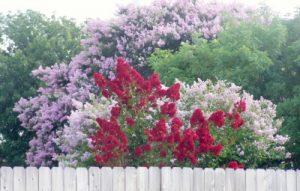 The chief one upon my mind of course, is why this has turned out to be such a banner year for crepe myrtles - honestly, for the past month, it seems as if every crepe myrtle tree has been covered in blooms to the exclusion of leaves. Underneath each tree, the ground is covered with the confetti of dried blossoms; pink, lavender, red and white. (Another mystery - has anyone ever bred a crepe myrtle with yellow or blue blossoms? If not, why not?) My neighborhood has quite recovered, thank you, from that bitter, bitter frost in January, which decimated potted plants and tender tropical plants. Just about everything that wasn't actually killed down to the roots has come back with a roar.
 Continuing my contemplation of mysteries; the taste of a neighbor who decorated their garden with a huge variety of healthy flowering plants in a collection of containers which have absolutely nothing in common, aesthetically speaking. It is almost as if they hit every nursery and DIY store in town, impulsively buying every plant and pot that caught their eye, without consideration of all the stuff they had bought previously. About the only thing to hold plants that they haven't bought so far is that nadir of low-rent taste, the automobile tire turned inside out, laid on the side, and the top edge cut into zig-zag shapes and gaudily painted. The assortment of pots would be striking of - but the statuary puts it painfully over the top.
 The horrible marching army of statues will have to come by the house with the tree full of wind chimes, the place where they have ripped out the lawn, and covered it all pavers, and raised beds full of native flowering shrubs, whirligigs, painted sheet- metal flowers and crystals on metal poles; all very pleasant on a mild day, but what it must be like during a wind-storm, I shudder to imagine.
 I love the look of the wind-chime place, but personally, I'm happy to be living a good distance away. I think it would drive my dogs and cats into nervous breakdowns. I blame global warming. Or global cooling. Or climate change, or Al Gore, or somebody. Maybe even Martha Stewart, whom I am happy to blame for anything.