No Bones About It: Bones are Unsafe for Your Dog

The idea that it's natural for dogs to chew on bones is a popular one. However, it's a dangerous practice and can cause serious injury to your pet.
"Some people think it's safe to give dogs large bones, like those from a ham or a roast," says Carmela Stamper, D.V.M., a veterinarian in the Center for Veterinary Medicine at the Food and Drug Administration. "Bones are unsafe no matter what their size. Giving your dog a bone may make your pet a candidate for a trip to your veterinarian's office later, possible emergency surgery, or even death."
"Make sure you throw out bones from your own meals in a way that your dog can't get to them," adds Stamper, who suggests taking the trash out right away or putting the bones up high and out of your dog's reach until you have a chance to dispose of them. "And pay attention to where your dog's nose is when you walk him around the neighborhood-steer him away from any objects lying in the grass."
Here are 10 reasons why it's a bad idea to give your dog a bone:
- Broken teeth. This may call for expensive veterinary dentistry.
- Mouth or tongue injuries. These can be very bloody and messy and may require a trip to see your veterinarian.
- Bone gets looped around your dog's lower jaw. This can be frightening or painful for your dog and potentially costly to you, as it usually means a trip to see your veterinarian.
- Bone gets stuck in esophagus, the tube that food travels through to reach the stomach. Your dog may gag, trying to bring the bone back up, and will need to see your veterinarian.
- Bone gets stuck in windpipe. This may happen if your dog accidentally inhales a small enough piece of bone. This is an emergency because your dog will have trouble breathing. Get your pet to your veterinarian immediately!
- Bone gets stuck in stomach. It went down just fine, but the bone may be too big to pass out of the stomach and into the intestines. Depending on the bone's size, your dog may need surgery or upper gastrointestinal endoscopy, a procedure in which your veterinarian uses a long tube with a built-in camera and grabbing tools to try to remove the stuck bone from the stomach.
- Bone gets stuck in intestines and causes a blockage. It may be time for surgery.
- Constipation due to bone fragments. Your dog may have a hard time passing the bone fragments because they're very sharp and they scrape the inside of the large intestine or rectum as they move along. This causes severe pain and may require a visit to your veterinarian.
- Severe bleeding from the rectum. This is very messy and can be dangerous. It's time for a trip to see your veterinarian.
- Peritonitis. This nasty, difficult-to-treat bacterial infection of the abdomen is caused when bone fragments poke holes in your dog's stomach or intestines. Your dog needs an emergency visit to your veterinarian because peritonitis can kill your dog.
"Talk with your veterinarian about alternatives to giving bones to your dog," says Stamper. "There are many bone-like products made with materials that are safe for dogs to chew on."
"Always supervise your dog with any chew product, especially one your dog hasn't had before," adds Stamper. "And always, if your dog ‘just isn't acting right,' call your veterinarian right away!"
Always talk with your veterinarian first before you give bones to your dog. And always, if your dog "just isn't acting right," call your vet right away!
 The neighborhood around Josephine and Grayson, just off 281 pretty well hits the mark, with the added benefit of being on the northern edge of the Riverwalk extension. Oh, how we love the Riverwalk - just can't get enough of it, here in San Antonio; eventually, I believe that riverwalk extensions and parks will go all the way through the city, from San Pedro Springs, all the way out to 1604 . . .
 I was drawn to the Pearl last weekend by a book-signing at
 All were pretty interesting, in themselves, but a good few of them were downright fascinating; it depended, I think, on how good a story-teller they were. A handful of them were at the Twig for the signing: Eddie Patrick was a kid genius, when it came to radios and electronics: he wound up as a senior NCO at the age of 19, serving at a Flying Tigers airbase in China, well behind the Japanese lines. Bob Joyce kept a diary, all through his tour of duty as a B-17 radio operator, flying a series of dangerous missions from Italy. On those missions, he carried a pair of regular Army boots, his father's rosary, a good-luck bracelet from his home-town girlfriend, and a $2.00 bill, so he would never be broke. And Granville Coggs went from being a Tuskegee airman at the very end of the war, to being a medical doctor, inventor, musician and senior athlete.
 Afterwards, we wandered out the back, towards the parking lot where the weekly farmers' market is held on Saturdays, and discovered that . . . well, stuff had changed since we were there last.
  the way downtown.
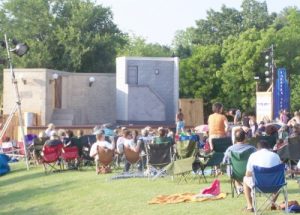 Perhaps it might come as a surprise to the bi-coastal cultural types to find out there is more to San Antonio than the Alamo and a greater variety of available forms of amusements on a weekend evening than high school football. I am always so amused by the insularity of said bi-coastal cultural elites - and the naked surprise on their faces when they find out that high culture and the arts are very much appreciated, here in the wilds of fly-over country. Helllooo McNay Museum of Modern Art! Lets hear a shout-out for the
 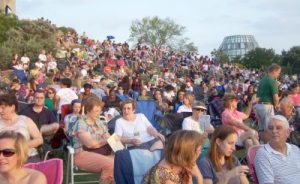 This is actually the second year that we have gone; last year, my daughter wanted to go - something to do with academic credit, I think - and it was unbearably hot, even after the sun set (which is when the performances begin) and there was a thunderstorm blowing in, lightening flickering clear on the horizon. We were high on the hillside, overlooking the natural amphitheater where the stage is set up, and the lightening was a suitable backdrop for "The Tempest" - envisioned by the producers as taking place on an alien planet after a starship crash. Alas, the actor cast as Prospero kept forgetting his lines; cringe-making for the rest of the cast, especially as Prospero is supposed to carry the play, striding like Gandalf the White through the ruins of Minas Tirith. Seeing the oncoming storm, and fearing to watch any more theatrical humiliation, we departed during the interval - but this year, the presentation by the company of the
 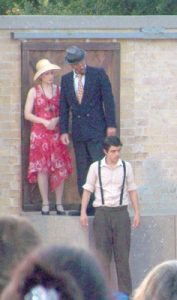 This time, it was Romeo and Juliet - with a local twist: the Montagues and Capulets being a pair of rival theatrical companies in 1929 San Antonio, with a Chief of Police, instead of a Prince of Verona, and the cast in full 1920's flapper dresses or shirts and ties with suspenders. Once one got past the odd conceit of rival performers going at each other with swords in backstreets and alleyways . . . and the oddness of hearing San Antonio, or ‘Santone' wedged in wherever Verona was named in the original text, it was quite tolerable, and the set was very clever; the stage-door of the Capulet's establishment revolved to show the inside of their house, and a sliding loading-dock door on the Montague side swung open to show the Friar's little cell.
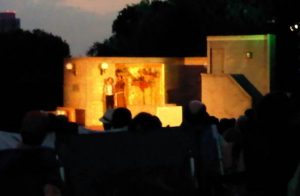 And this time- unlike last year - the hillside was practically standing-room only; a solid mass of people and folding chairs all the way from the edge of the stage to the top of the hill where the observation tower is. The only drawback to having a completely wonderful evening of it is that no outside food and drink might be brought in, which prevents one having a kind of lavish Glyndebourne Opera Festival experience, and kicking back to watch Shakespeare under the stars, assisted by a flute of champagne. Ah well, at least we'll always have Shakespeare and Majik.


 The larger and more out-laying towns still maintain a corporate identity, with things like city halls, fire departments, animal shelter and public parks - of which Converse's city park is definitely one of the finest. This was the location for the third annual spring jubilee, to benefit the local
  The park was green and very well kept, with a winding seasonal creek cutting across one part, the banks well-grown with yellow Indian Blanket wildflowers - alas, it was terribly hot, even early in the day, so we were wilting by half-past noon. The lady selling orchids was not, or the pleasant young man selling very clever little wooden plant hangers, for suspending any number of small pots from notches cut in either side of a long plank. This kind of arrangement would be perfect for someone trying to garden from an apartment balcony, for the plants would spread up and down, rather than out. The
  I think we spent the longest time at a specialty tee shirt booth - there were quite a few original designs, some of them to do with the Twilight books, and a lot to do with zombies. My daughter liked the "I fight like a girl" design. The designer has a regular booth at the Eisenhower Road flea-market: the inspiration for this particular design was her own daughter . . . who is, thank you very much - very, very, very good at personal self-defense. (So is mine, thanks to eight years in the Marines.)


 I think very fondly of re-enactors when I am working up a book, especially when I am working on a bit of historical fiction about Texas. Next to the public library, and the second-hand bookstores like Half-Price Books, there is no better way to figure out how something works, looks, smells, handles and feels than . . . well, checking out the fantastically dedicated re-enactor community. I first realized this, when I was working up the first book of the
  The oddest thing about the Paterson was that it was actually rather a small weapon, dull matte metal with a polished wooden stock. It fit my hand comfortably, and I have rather dainty hands. The revolver that made things equal in a fight between Jack Hays Rangers and the Comanche was actually… rather small, especially in comparison with the next iteration, the Walker Colt. The collector who showed us all this told me he has a pair of those, as well. The Walker is a massive weapon, weighing about four and a half pounds. After expending all six shots, anyone armed with one would have still had a dandy club/brass knuckles. No wonder they were immediately popular. But after wearing a pair of them on a gun-belt for a whole day of re-enactor events, he really, really felt every ounce of them, in a considerably painful way.
 Another amusing element: gentlemen re-enactors of early Texas days are splendidly turned out in the finest early 19th century finery; waistcoats, high-buttoned jackets, tall books and all, even to fancy spurs with jingle-bobs on them. The Texians at the Alamo, dressed in their best, may have looked very much more like Mr. Darcy than Shane: no cowboy hats or boots, no jeans, nothing like what people are used to think of as “western” dress. These gentlemen of early Texas wore tall top-hats, or billed caps, tail-coats or hunting coats made of heavy canvas or buckskin, trimmed with fringe – and very fancy waistcoats. That was a very male bit of a splash- the fancy waistcoat, especially when accessorized with a huge hunting knife. And his gentle lady carried a pretty big hunting knife as well. After all, a lady must always be armed against ungentlemanly advances … with whatever comes to hand.
 Back in the old days, shelter was almost everyone’s first need, upon settling on a homestead, that and planting some kind of crop in the ground. A marvelous book called “Texas Log Buildings; A Folk Architecture” differentiates very clearly the difference between a log cabin, and a log house. A cabin was small, dirt-floored and windowless, put up as a temporary shelter, whereas a house was larger, permanent, and carefully constructed; even elaborate. Many such were covered with siding and paint as soon as their owners could afford to do so. Frequently, the temporary cabin was reused as a smoke-house or a stable.
 Roofs were usually constructed with the gable-ends on the sides of a two-slope roof, with pairs of rafters lap-jointed or mortised together at the roof-ridge, at about a 45-degree angle. Long lathes or slats run cross-ways between the rafters. Most log houses were roofed with cut shingles. Attached porches and sheds would usually have a shallower roof line, described as a “witches’ hat” in silhouette.