Today's Lackland Air Force Base
 Lackland Air Force Base, popularly known as the “Gateway to the Air Force,” is located at the edge of San Antonio’s south-west suburbs, and is unique for several reasons. It is a training base, and has been ever since construction began on a permanent facility to train aviation cadets in 1941. If you have served in the US Air Force at any time since the Korean War, the odds are very high that you have come to Lackland, since it was designated the main training base for officer and enlisted Army Air Force recruits in 1946, and continued in that capacity for the Air Force – although wartime demands during Korea and Vietnam sent overflow training missions temporarily to other bases in Texas, California and New York.
Another singular oddity of Lackland is that for many years, it was an Air Force base without a flight line. Beginning as just another annex of Kelly – and housed in tents and flimsy temporary barracks, Lackland drew in more training missions, more and more buildings and schools, eventually becoming the sole provider of enlisted Basic Military Training (BMT) for regular active duty Air Force, Air Force Reserve and Air National Guard, even as Air Force basic and commissioned officer training moved to Maxwell AFB, Alabama. Ironically, in 2001, Lackland’s parent base of Kelly AFB shrank to a mere field annex of Lackland, following the closing of the San Antonio Air Logistics Center. With that closing, Lackland finally acquired an operational flight-line and a flying mission. Being relatively new, in contrast to established military bases around San Antonio – Randolph, Brooks, Kelly and Fort Sam Houston – Lackland itself boasts little in the way of historic buildings. Historical relics are confined to a half-century of aviation history, on static display around the perimeter of the parade grounds. Aircraft on display there include a B-52 Stratofortress, F-4 Phantom II, an SR-71 Blackbird, C-121 Constellation, B-17 Flying Fortress and a B-25 Mitchell. Every Friday morning, Lackland AFB hosts graduation exercises and parades at that parade ground, for graduates of Air Force Basic Military Training.
 Well into the 1990s, much of Lackland was housed in WWII/Korea era one or two-storey temporary buildings. Beginning in the late 1960s, when these structures were well past their “best if used by date,” substantial renovations and upgrades began with the construction of Wilford Hall. A modern, permanent 9-story hospital building and a 500-bed wing added several years later replaced a sprawl of 94 flimsy temporary buildings. A series of huge, and rather futuristic-appearing structures – with a ground-level core housing classrooms, mess halls and offices, and multiple upper-level barracks wings, built out on stilts above concrete pads which afforded shelter from the weather consolidated and replaced facilities which had formerly been scattered just as much as the hospital operations.
Today, Lackland hosts more than just Basic Military Training. Working dogs and handlers for the DOD and various federal agencies are trained at Lackland, as well as Air Force Security Police personnel, pararescue specialists, explosive ordinance disposal experts and tactical air control, as well as enlisted aircrew specialists are all trained at Lackland. The Air Force Audit agency, Air Force News, and Tops in Blue – the annual traveling Air Force talent contest are all headquartered there as well as the Defense Language Institute’s English Language Center, and the Inter-American Air Forces Academy, which offers technical training for enlisted students from Air Forces throughout North and South America and the Caribbean. Another portion of Lackland, formerly a part of Kelly, is the Security Hill complex, which houses the Air Forces’s Intelligence, Surveillance and Reconnaissance Agency, among others.
Nearby attractions include San Antonio’s Sea World, and Nelson Wolff Stadium, home of San Antonio’s minor-league baseball team, the San Antonio Missions – who often host ‘military nights.’ Suburbs and developments close to Lackland include Lackland Terrace, Rainbow Hills, Adams Hill, Heritage and Oak Creek.

 As the
  And so has the community of Boerne done, for a number of blocks paralleling River Road, on either side of Main Street. There is a generous paved trail, some added landscaping and stone work, paralleling the northern bank of Cibolo Creek as it runs through town. It seems that back in the day, Cibolo Creek was just as prone to overflow its banks and flood out parts of Boerne – just as the San Antonio River did, although on a much grander scale. We had noticed the new construction being done on the park, once we discovered Route 46/River Road; the back way between San Antonio and Boerne. So, last weekend we took advantage of slightly cooler temperatures to make a return trip to Boerne, as my daughter had her eye on certain items at the
 We had lunch at the
  The Riverside Park already seems to be popular; we saw one family eating a picnic lunch, and a number of others settled in with fishing gear, sending their hooks into the lazy green water. The ducks and geese had all sought out shady places, on the opposite bank, though. The only other water critters we saw were turtles; and we didn't realize at first that they were turtles. I thought their heads sticking up above the surface were just lengths of broken branch, until the heads vanished below the water, and there was a soup-bowl sized turtle, just dimly seen, diving down into deeper water.
 Just north of
  In my last post I outlined what I would like to have as my dream
  I'd actually look to having a good-sized vegetable and herb garden; what I have now but expanded at least four times. I have read good things about
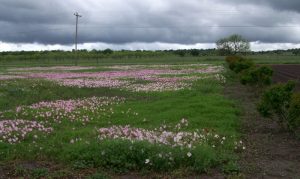 I'd add a scattering of trees to the oaks on my dream property; at least a couple of almond verbenas, which start as shrubs and with any encouragement at all turn into medium sized ornamental trees. They are not much to look at, but the clusters of tiny flowers have the most amazing sweet almond smell. I'd have some redbud trees for the look of them, and finally a couple of bearing fruit trees; peaches, or plums most likely, and a good pecan tree, too. The trees would bridge the gap between the practical vegetable garden, and the ornamental garden – which would be heavily tilted towards native and native-adapted plants which look after themselves, pretty much.
 There would be roses, though – I couldn't get along without roses, although they would also be the hardy sorts, and picked out more for their scent than their appearance. There would be shrubs to attract birds, butterflies and bees, much as I have now, only spread out a little more generously. I'd have a large area close to the entertainment kitchen and the grill paved in brick or stone ... and that is where the main garden ornament would be; a fountain; a good-sized tall stone one, rather like the ones that adorn the private courtyards in the old houses I used to see in Spain, with a wide enough ledge to sit on surrounding the lower pool. And when I had a party, the guests could enjoy the sound of trickling water, the scent of almond verbena, and look at the late afternoon sun setting in the distance ...
 Fort Sam Houston is considered to be the home of Army medicine, since all Army medical training was consolidated there at the end of World War Two. The Base Realignment and Closure Commission of 2005 recommended that all military medical training be consolidated at Fort Sam Houston – popularly known as “Fort Sam.” Both Navy and Air Force medical training programs are scheduled to move from their present locations in the near future. But Fort Sam was not always the home of military medicine – for at least fifty years, it was the main supply depot and headquarters for the US Army on the southwestern frontier . . . and in 1910 it was the birthplace of military aviation, when then-Lieutenant Benjamin Foulois took off from the parade ground in a 1909 Wright Flyer, dubbed “Army Airplane #1” for a series of demonstration flights.
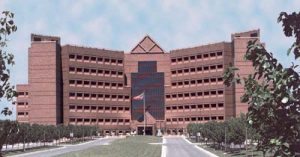 Since many of the approximately 900 historical structures on post - quarters, barracks and administrative buildings - are still in use, only the Quadrangle is open to the general public. However, there are two museums on post, which between them give a very good idea of the scope of Fort Sam’s history and present missions: The Fort Sam Houston Museum, and the US Army Medical Department Museum. In addition to serving as headquarters for Army Medical Command, Headquarters for US Army South and US Army North, Fort Sam also hosts Brooke Army Medical Center.
 Although I have only one huge okra plant, and a couple of others which have produced intermittently and spasmodically, individual okes (is that the singular of okra, like meese should be the singular of moose?) my garden just doesn't seem to produced sufficient of them in a short period of time to make a decent batch of okra pickles on any given day. At least, not enough to be worth firing up the canning kettle. It's really not worth heating up the kitchen in my
  Meanwhile, pack the raw okra into 2 hot and sterilized 1-quart jars, and tuck in among the packed oke pods in each jar, 2-3 peeled and lightly crushed garlic cloves, 2-3 dried chili pods (I used ripe red jalapeno and paprika pods from my garden) and two or three small bay leaves ... I have a small bay tree in the garden, so again ... from my garden. It helps to pack the first layer of okra in the jar with the wide end down, and then wedge the next layer into it pointy end down, and distribute the garlic cloves, the pepper pods and the bay leaves as they fit. Fill the jars with okra and all until just below the point on the jar where the threaded rim begins, then pour in the hot brine and process at least 20 minutes in boiling water, as per the usual canning instructions.
 I have about decided what I should like to live in, as my
  No, what I would like in the way of the retirement property is pretty much what my parents got for themselves, when all of us had flown the parental nest; they built a nice house with a verandah all the way around it, on a knoll with a view out in the country. I wouldn't go as far out as my parents did – for much of their lives together, directions to their current residence usually included the phrase, "Turn off of the pavement and onto the dirt road." I've a liking for paved roads, myself – bouncing from rut to rut and dodging the gullies carved into a dirt road after a rain is not my idea of fun.
 But I would like a house of a certain sort – a small one of a particular tradition. Not a single big house, but an eccentric collection of cottages, set in a rambling garden. A little house of mine – and two or three others, one for my daughter, and another one or two which would serve as guest quarters when I had company, just enough set apart that we all would have privacy. I'd love to have a well, with one of those old windmill pumps, to bring the water to an above-ground concrete or wooden cistern on legs ... just as I have seen on some old properties here and there. There would be a scattering of oak trees – post oaks, live oaks, red oaks, for the shade, and to hang a wooden swing from a thick branch that parallels the ground.
 The grounds around would be planted with native plants and tough adapted old roses, a tangle of jasmine somewhere, which would bring their scent in through the windows on those spring days before the summer heat sets in. There would be a wildflower meadow on the part of the property distant from the houses and I'd like a bit of a view from here and there, so my dream house and the others would probably have to be on a gentle slope. I don't need a spectacular view, but I would like it to be mostly of countryside: Rolling hills, and all of that, maybe a glimpse of a distant creek or river. I think I would like the view to be towards the west – to catch the sunset, late in the afternoon.
 As for the little houses on the property ... I would love them to be Craftsman-style bungalows or small Texas farmhouses, maybe even a one or two of them might be repurposed log cabins. There are one or two lovely ones that I have noted here and there and admired extravagantly. I am thinking of the kind with a main room and a loft bedroom over, a kitchen lean-to on the back and a deep porch across the front. One or two of those would suit just fine, but even just a couple of those kit houses from Home Depot would work well, assuming that I could adorn them with vintage architectural surplus.
 Randolph Air Force Base
 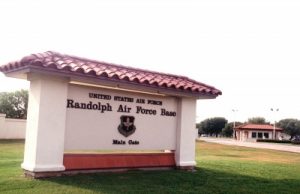 The original plans for Randolph were drawn up by a young officer, 1Lt. Harold Clark, who- although having trained as an architect – was serving as the dispatch officer in the Kelly Field motor pool. He used the back of old dispatch sheets to sketch out his idea of a perfect “Air City,” which he daringly showed to General Lahm. General Lahm was so pleased that he made Lt. Clark the architect-in-charge of the building project. Work was undertaken on the new project by the US Army Corps of Engineers – the largest project they had undertaken since completing the Panama Canal. The entire complex was finished in three years. Ironically, Captain William Millican Randolph, the flier for whom the “air city” would be named, was actually a member of the name-selection committee, when he was killed in a 1928 air crash at Gorman, Texas. (Capt. Randolph is buried in the Ft. Sam Houston Cemetery.) The resulting facility was built in a very pleasing Art Deco and Spanish Colonial style, of hollow-core tile and conblock covered in stucco, with tile roofs. Many were built to standard institutional plans common to the time, but many – like the Taj – were unique, and one-off structures.