Frugality – Part One
by Celia Hayes
 I suppose I have come by the predilection for thrift in a fairly straightforward way – I inherited it. There are things that because my parents didn't do them, I never actually have or would in the foreseeable future. Like purchase an entirely new automobile. Do you know how much it depreciates, as soon as you drive it off the lot? I can hear Dad lecturing me, even now. At least two years old, lightly used, dealer warranty.
Not even if I should become a fabulously wealthy and famous writer, the Margaret Mitchell of the Hill Country . . . nope, although I have now and again spent money unwisely, I just cannot bring myself to spend full retail on certain things. Apparently I am not alone in this, these days. As my mother said of certain items of classic fashion; "Hold onto them long enough and they will come around again." So, these habits of frugality have most assuredly come around again, in these troubled economic times. I can let them out for a romp, and bask in the glow of being fashionable! (This last happened when I first got into blogging – hey, for about a year or so, I was cutting edge!)
I guess the first overarching principle is – don't fear second-hand! Second hand is cool, quirky and devastatingly original! It wasn't made in China – it may even have been made in America! It is even ecologically sound, if that floats your boat. Best of all – it's cheap. There are things that it is just more sensible to buy second hand: books, for instance. DVDs. Clothing – lightly worn, clean and good quality, of course. Older, vintage items might even be better quality for the same price as something brand new – but cheap. The same goes for shoes, but extra emphasis on the lightly-worn. Accessories and decorative elements, jewelry – say, what do you call second-hand jewelry which has been around for a while? Vintage, if not actually antique. China, pottery, and glassware; you'd be blown away by the quality and good value of items available at estate sales, garage sales and thrift stores.
Speaking of antiques, that's another good second hand purchase: good solid wood furniture. Something made twenty, thirty years ago, of solid wood with a little wear and tear on it will still be something more solid, more worthwhile, elegant, and possibly even more interesting that a something made last week from a slab of glued and compressed sawdust covered with cheap veneer. Consider this, also – that solid piece of good wood furniture is already broken in!
Second-hand upholstered furniture is something I am in two minds about – considering that liquids (including human and animal bodily fluids – yuck!) might have been spilled into it, all kinds of microscopic and larger vermin might have made a happy home therein over the years that it has been in use. Basically, unless it can be dry-cleaned, or run through an ultra-hot washing machine cycle with bleach, I'd give it a miss. . . . this applies to pillows, too. And mattresses. I might be budget-minded, but I am also fastidious. Generally, these last fall into the category of things one should go ahead and purchase new, but your mileage and your skills at upholstery may vary.
 So, who would have guessed that there is a thriving little Italian community tucked away in San Antonio ... well, if you have passed by at speed on the IH-35 North, just where the highway passes Navarro and Santa Rosa, you would have caught a glimpse of a tiny, ornate brick church – the Church of San Francisco de Paoli, with the Columbus Hall right next to it and the beginnings of an ornate public square and gardens out in front. The church and the hall were built by a social and self-help society formed of Italian immigrants at the turn of the century last – the
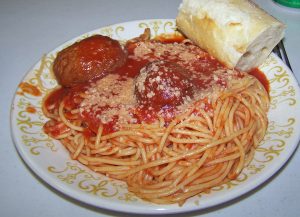
 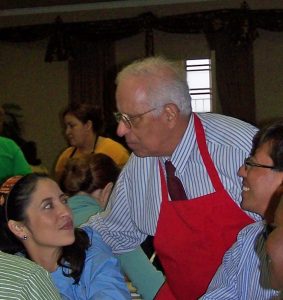 Every quarter, the Ladies Auxiliary of the CCIS holds a spaghetti and meat-ball dinner, and because this is Columbus Day weekend, the feast coincides – and even with the rain, the line for seats went all the way out into the foyer, out the door, and down the steps to the sidewalk. There were supposed to be a number of vendors, a bocce tournament, some bouncy-castles, face-painting and all sorts of family fun in the square . . . but alas, with the first serious rain in months, that was just not going to happen. I am certain that hardly anyone missed those activities, as they were coming for the food anyway: just simple red tomato sauce, over spaghetti, and a pair of meatballs, but oh, those meatballs! Light and flavorful, the meat ground very fine . . . and afterwards, if there were any room left – a choice of desserts: cake, and cannoli, pizelle cookies, cupcakes and cheesecake. We shared a table in the hall – which is very nicely set up as an event venue and apparently does a roaring business as a site for
  One of the non-dessert items for sale was a cookbook generated by the Ladies Auxiliary – and which everyone assured us contained the meatball recipe; scaled down about a hundred times I am sure. Actually the cookbook has no less than four recipes for meatballs. Because of the bread content I am fairly certain this one comes closest to the scrumptious main course:
 That was a wonderful time, although I didn't really get to meet any of the other authors. Readers of books and local supporters of the Eugene Clark library got to purchase books and talk to the authors, while sipping wine and nibbling on a scrumptious array of finger food, cheeses, sweets and whatever, provided and served by students from the
  I had only one opportunity to give a mini-lecture to a full table: how important it was to know our history, how I came to write historical fiction as a way to teach people about it . . . and the best way to teach people that history is to make a ripping-good and readable yarn (while still being historically accurate!) I also had the chance to face one of my greatest private dreads – a descendent of a villain. Ever since the Trilogy came out and I began doing book events, I've met people descended from those historical figures which I wrote about in it: C.H. Nimitz, Dr. Keidel, Herman Wilke, Louis Schultze and others. Those descendents I have met have been pleased with how I 'wrote' their ancestors, although one sniffed that she had never heard of CH Nimitz ever being called 'Charley'. Anyway, one of the attendees was a descendent of the notorious 'black hat' J.P. Waldrip . . . and as she whispered to me, upon departing from the table it appears from the family records and memories – that he was pretty much as I wrote him. I love it when I get things right – even if it comes through instinct.
 Having reason last Saturday to go up to Lockhart, to participate in an evening fund-raising event to support the Eugene Clark Library, my daughter and I thought; let's drive up in the early afternoon and take a look at the sights of historic downtown Lockhart; a district of several blocks centered on the archetypal Texas courthouse in a square with a number of businesses housed in classic late-19th century or early 20th century buildings.
 There is a weekly farmers' market in the mornings – which we missed – but we had been told about a consignment shop called the Citrus Peel and my daughter was enthused. She came up with a winner immediately; a leather Doney & Burke mini-planner . . . and a charming funky vintage handbag shaped like a western saddle. We both loved it, talked about over lunch and went back for it, agreeing to split the cost and custody, having never, ever seen the like of it before. (Looking it up online, there are a handful of them in the same design: Mexican tooled leather, but different colors and slightly different pommel/cantle detail. Not mass-manufacture; likely a craftsman in a leather-goods shop in a border-town, doing them one at a time for the tourist trade.)
 We chose BBQ at Kreuz Market for lunch, which was good, if not quite as sublime as we had expected. The side dish beans were excellent, and the hot German potato salad had an admixture of sauerkraut in it – very tasty. Afterwards, people told us we should have gone to Blacks, or Smitty's. The first rule of road-food: always go where the local people say they go.
 We were also referred to the Main Street Gallery, which is set up in a lofty old building which the owner, Johnny Lay, explained had used to be a stable. Now it is fully stuffed with lovely antique furniture, stained glass panels that my mother, the stained glass hobbyist, would give her eyeteeth to be able to replicate. There is a case of Civil War era tintypes and daguerreotypes, most of them just the size to fit into a pocket, and some really splendid art glass. There was also a long shelf of books; among the few things that I could afford. This is one of those antique shops which I would love to furnish an entire house from, once I have become a very rich and famous writer. (The other is Back Alley Antiques, in Artisan's Alley here in San Antonio).
 We finished up at the Southwest Museum of Clocks and Watches, open on Saturdays and by appointment; which guided tour was a great deal more fun than most guided tours usually are. The single most amusing item in the museum is a concoction of dark mahogany which once belonged to showman PT Barnum: A clock-desk-music-box-organ, which was stored in a local barn for nearly seventy years and restored by the museum staff. They also have the original works from the clock in the tower of the courthouse . . . which has also been recently restored.
 That is something which sounds vaguely like something which only ought to be done by consenting adults, in private and behind closed doors, but . . . well, it's really rather prosaic, in the process of making cheese. It's the final thing done, before stashing the wheel of cheese in the lower shelf of the refrigerator to age for the required number of months. Well, to all but the parmesan; that variety ages, dries and hardens bare and un-waxed for a year, before getting a slathering of olive oil. It will be another ten months before we can even sample it and know if it is any good, but it already is looking dry and waxy, rather like the less expensive supermarket parmesans.
 We even ventured into the purchase of some small, lidded pottery crocks for soft cheese, although the only kind of soft cheese we have accomplished this far has been by accident. My daughter has made gouda, smoked gouda, cheddar, fennel-flavored cheddar, and a couple of the other more complicated varieties . . . but just cannot get the hang of what is supposed to be the easiest: mozzarella. Aside from the very first batch, which she did from a kit – every other batch has come out disastrously. Once, it emerged from the hot whey bath as a hard waxy yellow baseball-sized bolus; every other time, it's come out as . . . well ricotta. Something goes wrong, even though the curds form and separate very satisfactorily.
 The United States Navy's Navy Flight Demonstration Squadron, popularly known as the Blue Angels, Is Coming to San Antonio on October 29th and 30th at the
  Within living memory, much of modern, built-up and suburban San Antonio was confined to well within the 410 Loop. I have friends not very much older than myself who can recall Nacodoches Road as a two-lane country road, doddling off into farmlands in the upland north of town, and those friends of my parents' age remember that the airport was away the heck and gone in the middle of nowhere, and Broadway at 410 was a dirt road. Here and there remain small islands and patches of rural activity: stone and frame houses of an earlier age, surrounded with crumbling outbuildings which once were barns and stables, marooned on a little patch of land while the tide of suburbia has all but engulfed all else.
 When I first moved to north-east San Antonio, there was a riding stable on Judson road, next to the Sam's Club: it is now closed and the
 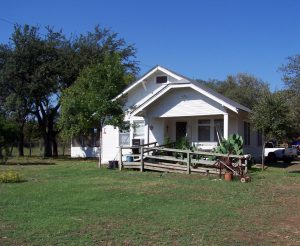 Now, one of the most significant rural enterprises remaining within San Antonio is embedded in Phil Hardberger Park, just about where Blanco intersects with the Wurzbach Parkway: more than three hundred acres of undeveloped wood and pastureland which formed the Voelcker Farm – a working dairy farm which was still operating under the original owner until just a decade or two ago. The farmhouse, the original farmhouse, the barns and outbuildings . . . and some urban cows are still there, as part of the park. Just last weekend there was a 'Dairy Day' event, aimed at educating children who may be a little uncertain as to where milk actually comes from (you mean, it doesn't just magically appear in a plastic gallon jug on the supermarket shelf?) and their parents, who may also be a little shaky on the concept.
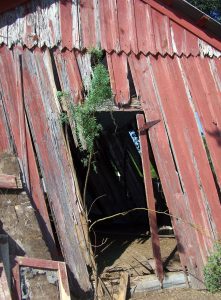
 The old farm complex is right next to the start of a section of the Salado Creek Greenway. Elements of the park and the trail are still under construction, and the older buildings, which are as historic as they are dilapidated, are scheduled for repair and renovation. Certainly one of the barns leans as much to one side as the old frame building on Josephine Street which used to house the Liberty Bar; one good sneeze or the next high wind might bring it down entirely.
 Alas, I arrived very late in the event: there was supposed to be a demonstration of milking a cow, and feeding calves, but by ten o'clock the cows were empty and the calves were full. The calves had retreated to an out-of-the-way corner in back of the most dilapidated barn, but the cows were mooching around in front. This, I think, must have been their most interesting day in months, but they didn't really seem to be interested in it. Cows are not exactly the life of the party animals.
 The Alamo Area Master Naturalists were there, handing out information on their classes, and little packets of native plant seeds and bluebonnet seeds, and also some flyers from the National Wildlife Federation, encouraging the planting of locally native plants. According to the Hardberger Park website, one of the long-time goals is to restore the original oak and meadow habitat – which is now quite overgrown with cedars and other invading species.
 Italian food is simple, natural, and just plain good. Come see what real Italian food is all about. Speaking Italian and eating Italian is the thing to do at the annual Christopher Columbus Day celebration; Sunday, October 9th, 2011 from 11:00am to 5:00pm at 201 Piazza Italia, San Antonio, TX 78207. Columbus Day was first celebrated on October 12, 1792 to honor the voyage of the Italian explorer Christopher Columbus' arrival in the America's in 1492 via a fleet of Spanish ships; the Nina, the Pinta, and the Santa Maria. You are invited to join your Italian-American family to celebrate their Italian heritage.
 The Festival is shaping up to be a HUGE EVENT with non-stop entertainment, music, Italian dancers, a car show, arts and crafts vendors, kids games, (including a moonwalk and facepainting), piazza e un torneo di bocce ... of course Italian food and more! Mark your calendars! Easy access downtown with plenty of parking. (Near the downtown hospital district where IH-35 meets IH-10; take Martin St to Columbus St. Look for Columbus Park.)