


Eating on the Go
by Celia Hayes
 Well, there is fast food, and then there is fast food – fast food that comes to the customer. When I was stationed in Korea such a convenience was called the 'chogi' truck, or as the local national employees called it 'roooch-coachie'. It came around mid-morning to the building where I worked, dispensing hot sandwiches, snacks, candy bars, ice cream and bags of salted or sugared snack foods. But the chogi truck is to a food truck today as a Model T is to a Jeep Cherokee. They're gasoline-powered motor vehicles, and they dispense food to the hungry ... but the 21st century food truck tends to be a specialty gourmet kitchen on wheels. Certainly in a large and built-up city, there would be lots of hungry lunch-time customers.
 Quite likely, a good number of those hungry workers would have exhausted all of the available and nearby restaurants and fast-food places. It's an expensive and time-consuming operation, opening up a new restaurant in a profitable location in the big city. Conventional wisdom has it that the odds on a new restaurant venture failing within the first three years of operation are fairly high – so starting small with a food truck is a logical solution. Without the huge start-up expense of real estate and a building – all the budding chef-entrepreneur needs is a kitchen on wheels, a map of the city - and one which permits food trucks to park on streets relatively unhindered - and a lot of hungry customers. These days, it also helps to have a Facebook page.
 Food trucks have a relatively long history, as these things go. According to the invaluable Wikipedia, the mobile kitchen/canteen had it's origins in Texas – in the chuck-wagon developed by Charles Goodnight for use on the long-trail cattle drives after the Civil War, when the Transcontinental Railroad had pushed far enough into Kansas to make Texas cattle profitable in the larger markets of the East. From the horse-drawn chuck-wagon, came lunch trucks, which provided meals to shift-workers in the big cities, especially those working the night shift around the turn of the century. This trend continued, of lunch trucks serving meals at construction sites, and setting up at fairs and festivals. The US Army maintained mobile canteens – kitchens on wheels, which are most likely the direct ancestor of today's food trucks.
 According to the same source, the current popularity for food trucks coincided with the economic downturn; a plentitude of food-trucks with no construction sites to service, and a similar glut of hopeful chefs with no restaurants to work in. Necessity makes opportunities – and in this case, a very useful one. Out on 281 and Thousand Oaks, outside the 1604 Loop, a far-seeing local entrepreneur established a sort of gourmet food park – the Boardwalk on Bulverde, set aside for food trucks and customers to meet, greet, and eat. My personal favorite food truck is permanently parked on Nacogdoches, next to the Cordova Auto Center; Ericks Tacos, which has Mexican-style street food to die for and funky street-dining atmosphere to spare. Oh – and look out for the green sauce; nuclear fission in a small plastic cup. On a book trip up to Abilene, we ran across Short Bus Hot Dogs – which is a hotdog stand set up in a converted school bus. And yes, they have a Facebook page. Charlie Goodnight didn't have any idea of what he set in motion, in 1866.
 Mary, Mary, Quite Contrary ...How does the garden grow? At this point, it's hard to say anything definite; for much of February I have been sidelined with the current flu, possibly in combination with a whopping reaction to all the pollen in the air for the last few weeks. All the plans for the garden were on hold until this weekend ... filling up the big raised bed with another humongous bag of good potting soil, constructing the first of several smaller raised beds, getting a dozen or so tomato starts planted in either home-made topsy planters or in the existing Earth Boxes, and planting the onion starts and the various beans. All of that ... and the thunderstorm which roared through in the wee hours of Sunday morning just seemed providential. I wish that we could count on a good solid rain every two weeks or so from now until autumn ... that, and the assortment of seed packets that I bought at Lowe's on Sunday will come forth and thrive as advertised.
 Beans, and peas, zucchini and summer squash and mesclun-lettuce mixes, oh, my. I used to have very good luck growing the mesclun and salad mixes from seeds from a specialty mail-order nursery during the first few years I was here and trying my best to have a usable, edible garden. Last season, the tomatoes worked out all right, although I honestly could have used more, more, more in the way of bearing plants. I'd like to have so much in the way of tomatoes and zucchini that I am reduced to leaving bags of them anonymously on my neighbors' doorsteps, running the doorbell and running away. I'd love to have enough bearing bean plants that I could go out every evening as I did in Utah, and pick enough fresh beans for dinner.
 As for the home-made topsys; I had very good luck with a number of inexpensive planters' pots from Lowe's, and making hangers to suspend them from picture-hanging wire. All I needed to do was cut a square hole in the bottom of the pot with the kitchen shears, and then cut an ordinary cellulose kitchen sponge in half. A slice halfway through the half-sponge and a hole for the stem of the tomato plant, fit the leaves through the hole in the pot, and fill up the pot with good potting soil, and we're in business.
 The three pots of eggplant from last year are doing OK; I finally moved them out of the greenhouse and into a sunny spot against the back fence. I have crossed my heart and vowed to actually eat the eggplants this time. There were four or five on the plants last year, but they went to seed before I got around to doing anything constructively culinary with them. Quite a few of the okra pods also went to seed – but there I got the good out of them and saved the seeds. Now I have a whole Earthbox full of okra sproutlings. My ambition as regards okra is to have enough ripe pods at one time to make a meal of, or possibly a single jar of okra pickles. And that's been my weekend in the garden – what about yours?


 Well, we'll need a bag or two more of potting soil to properly fill up the big raised bed that I wrote about a couple of week ago, so there'll be a delay in planting it. There'll also be a delay in constructing the two narrower raised beds, which will be placed against the fence, with a bit of latticing attached, so that that plants which wish to climb – like beans, peas and cucumbers – can go to town. The big bed will be planted with zucchini and summer squash, which are supposed to produce by the ton, but which last year got attacked by some nasty kind of crud/parasite which attacked their stems and killed the plants themselves almost overnight.
 The one remaining topsy that I don't think we will use this year is the one for peppers. I've removed all the plants which survived from last year, and replanted them in large pots – just like I did with the ones from the year before. All the peppers – cayenne, Bell and jalapeno alike – are thriving. The one seedling vegetable variety that we do not need to re-stock the garden with this year is pepper. Seriously, I think there must be about fifteen individual pepper plants.
 Which brings me to a lament a local casualty of the drought over the last couple of years; the Antique Rose Emporium outlet on Evans Road has closed. It actually closed six months ago, and when I first heard of this, I thought it must be a rumor. Surely we had been there – just before Christmas, sometime in September, I thought. But no – and there went a place which not only supplied me with darned near everything the least little bit exotic in my garden, but with gave me an example of what a beautiful, blooming, native Texas garden could be, stocked with roses and herbs and adapted perennials! So passes the glory of one of my favorite retail outlets, although there is some comfort to be had in knowing that their main establishment and website is still in business. I have no idea where we will go now for vegetable starts and herbs; split our devotion between HEB, Lowe's and Rainbow Gardens, I guess..
 When just about everything in the garden was done producing for the year and the weather began to cool off, my daughter and I put up the folding gazebo-greenhouse which one of our
 As it turned out for us last year, although the hanging turvy planters, the earth boxes and the pots of various sizes produced a splendid-looking assortment of vegetables, and the garden looked nearly the best that it ever has been, the actual crop wasn't that impressive. It wasn't enough to entirely supply our salad green and vegetable needs throughout the summer and fall, and certainly not enough that we were going around to the neighbors leaving sacks of zucchini and peppers on the doorstep, ringing the doorbell and running away.
 So, this year, we're moving on to Plan ...well, by this time it is Plan C. Plan A, back in the beginning was in just digging in lots of sand compost to what is essentially hard clay – which worked for some things, but but vegetables. Plan B, which was to plant the vegetables in containers, was what we did last year – and there just isn't enough container space. Plan C is – a series of raised beds, made from wide pine planks, and filled with compost and good potting soil. This is what we have started; last weekend I built the largest one, from a pair of 12-foot planks, which the nice people at Lowe's were kind enough to saw into 4 and 8 foot lengths. Four pairs of corner joist fasteners and a handful of wood screws – and there we go. Fill with soil, and put square concrete pavers around the edge so that we're not waiting through the mud every time we water ... and there's the first raised bed. We should be able to build and fill two or three more, and fit into various unused spaces in the back yard, which will offer lots more space for vegetable-growing.
 We've carried over enough cayenne, jalapeno and bell pepper plants from last year that we need not buy any more for this year. Alas, one of the tomato turvys has split and disintegrated under the stress of two years hard use, and I suspect the remaining two are very close to following suit – so, here we go, looking for more. With the greater space available in the raised beds, we might better be able to grow more squash, zucchini and bush beans – and just today when we were at Lowe's for some shelf brackets, I noticed that they had bags of onion starts and seed potatoes ... and those are definitely things that I'd like to have. And that's the plan for my garden this year – what's yours?
 Knowing how important historic 'firsts' are to civic life and the partisans of hometown institutions, I expect that any day there will be a showdown between Lockhart and Galveston over which town has the oldest continuously operating public library in Texas. A routine googlectomy turns up the competing claims of the Rosenburg Library in Galveston (1871) and the Dr. Eugene Clarke Library in Lockhart (1899), despite the 30 years difference. Perhaps the Rosenburg Library was sidelined in the aftermath of the great hurricane which struck in 1900, and that is why the 'continuously operating' caveat is in play.
 In any case, San Antonio's public library system was late to the game, with the oldest library branch only opening in 1930. (It's the San Pedro Branch, in
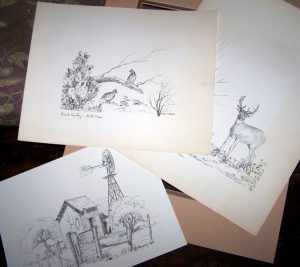
 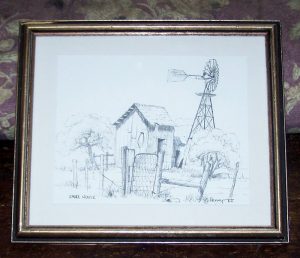 In last week's post I mentioned the gifts that I was intending to give to three people who – because I am in business with, sporadically employed by, or just really, really fond of them – rate something a little more permanent than a jar of pickled pineapple spears and some fig jam. Of course fruitcake is permanent – but it's not something you can hang on a wall. Among the items that my daughter and I bid on when we went to an estate auction in Fredericksburg this summer was an envelope of prints. They were by two local artists, of Texas subjects, were printed on high-quality paper and rather pleasing to look at, if not particularly valuable. I had the notion to frame three of them properly and present them as gifts – but as as relatively un-famous published author – I had to do this on a budget. But inexpensive does not mean cheap-looking, given some basic materials and a little know-how.
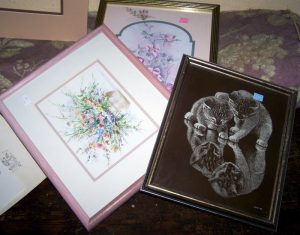
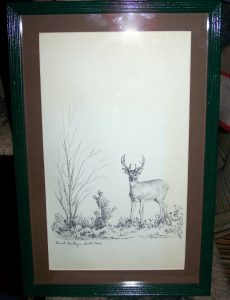 Two of the prints were a fairly standard size – 9x12, and 10x14. The third was a little larger – 14x20 – but even so, finding good-quality frames to fit them was a breeze at Thrifttown, which had a whole rack of picture frames in various sizes for $2-$7 apiece. Of course, all three came with rather awful art already in them, but that is what the trash can is for. One had a nice mat, which I saved. I also saved the hardware to hang it from. Then I peeled off the paper backing and disassembled them all; the frames needed some minor touch-ups, and the glass in each was filthy. Two frames had the contents held in with glaziers' points, the third with staples, but all were easily pulled out with a screwdriver and a pair of pliers. I used the glass from each frame as a guide to cut three new backs from ¼ inch foam-core board.
 The three sheets of glass went into the dishwasher and came out perfectly clean and spotless. The frames were a different matter. From out of the shelf of painting supplies in the garage, I retrieved a can of periwinkle blue spray-paint, one of hunter green, and one with a little gold left in it. The smallest of the frames only needed a little touch-up – gold sprayed onto a paper towel, and then dabbed on the places where it had worn off. I carefully sprayed the other two frames and let them dry ... and when they were, I went off to Hobby Lobby with the largest and smallest frames and the large print to see about mats. There's a good selection of pre-cut mats available, but the print of the deer in the brush needed to have one specially cut because of the non-standard dimensions. Cost - $10 for the two mats.
 That accomplished, I set about reassembling them – first with the clean glass put back into the frame. Then I used a Uhu glue stick to lightly coat the back of the mats and center them onto the prints. Each went into the frame on top of the glass, making certain that there weren't any specks of dirt or lint or anything on the glass, or the matt and print. Pop in the foam-core and secure it with glazier's points, and then to the next to final step: another swab of the Uhu glue stick all around the back of the frame and press a sheet of brown wrapping paper cut a little larger than the frame carefully onto it. When the glue dried, I trimmed off the excess all the way around with a razor-blade and replaced the hardware ... and there's a lovely and meaningful set off gifts. Two out of the three recipients loved them extravagantly, which proves to me that it's not the expense, it's the thought that really counts.