


I Love the Smell of Chili in the Morning ...
For much of the 19th century and into the early Twentieth, this was a popular San Antonio thing – various of the public squares, notably Military Plaza and Market Square were the domain of the Chili Queens who established the custom of setting up tables and benches along the edges of the square, in the early evening and selling chili-by-the-bowl to all comers. They would bring huge kettles of chili which they had made over their own home cook-fire during the day, and keep it warm through the evening and into the wee hours.
Very often the chili vendors would entice customers to their own particular stands by hiring musicians to entertain diners. There are some splendid descriptions of how marvelous this would have appeared – lantern and starlight shining down on the tables, gleaming on glass soda bottles, while the scent of the chili and the mesquite smoke from the fires which kept it warm hung on the night air. During South Texas summers before the invention of air conditioning, this likely would have been about the most comfortable dining venue for working men, for those out for an evening of gambling and drinking in the various saloons ... and in later decades, for those visiting from the North or the East, desirous of absorbing a little exotic local color.
And it was a very local delicacy in those years. Texans took readily to a venison or beef stew highly spiced with local chili peppers (with or without beans, with or without tomatoes), especially in the borderlands. But it was also a seasonal dish – generally only served in the spring and summer when the fresh peppers ripened and were available in the market. Air-dried whole chilies were available, of course – but they just didn't provide the same flavor-punch. There may have been many local gourmands who adored chili and wished to eat it year round, but only one of them did anything about it.
This was a German-American, Willie Gebhardt, who got his start in food entrepreneurship by owning a beer-garden and restaurant in New Braunfels in the 1890s. It's often said among the Irish that there was an Irishman at the start of any interesting cultural, technological or scientific effort, but in Texas in the late 19th century this most usually fell to a German. Willie Gebhardt, like many other local cooks, developed his own special recipe for chili, and served it often in season – but on the side, he began experimenting with a means of preserving the essential chili pepper flavor.
Eventually he hit upon a means of soaking ancho chili peppers, garlic, oregano and cumin in a water-alcohol mixture, then grinding it into a stiff paste, which was dried under low heat. When dried, it was ground into a powder using a coffee-grinder, and packed in air-tight glass bottles. It was immediately popular; Willie Gebhardt took out a patent, calling it Gebhardt's Eagle Brand Chili Powder. By the turn of the century, he had opened a factory – patenting a number of machines to expedite the manufacture of chili powder, which became and still is insanely popular. Eventually his factory, under the direction of a brother-in-law branched out into providing ready-made canned chili, and other staple Tex-Mex foods.
Since this cuisine was largely unknown outside of the southwest, Gebhardt's company published a cook-book instructing American cooks how to use chili powder – the first nationally-distributed cook-book on Mexican food. The original recipe for Eagle Brand Chili Powder is still available, supposedly unchanged, although the company was sold to Beatrice Foods following on the death of Willie Gebhardt in 1956. (It's available on Amazon – so is a facsimile of the original Gebhardt's Mexican cookbook.)
 Ah, yes – Fiesta Time is here once again; San Antonio's very own Mardi Gras but with more couth. Or at least we like to think so. Around here, when the floats with the Fiesta female nobility pass, the crowd shouts, "Show us your shoes!" and not anything more revealing than that. Of all the scheduled events during a nearly-two-week-long city-wide block party, one of the most well-attended (to judge by the crowds every evening) is NIOSA, or Night In Old San Antonio, which features every kind of food booth imaginable in the little squares and streets of La Villita. One of the long-time favorites of NIOSA is a South American version of meat-onna-stick called 'antichucios', which a long-ago volunteer discovered while on an assignment in South America.
 The recipe that I found calls for a marinade made by whirling 4 chopped jalapeno peppers in a blender with a little water and adding the resulting pepper slurry to 1 ½ cups red wine vinegar, 1 cup water, 1 tsp each cumin, paprika, and oregano with 2 tsp salt, ½ tsp black pepper, and a couple of crushed garlic cloves. Cut one large beef tenderloin or sirloin or top round into 1-inch cubes and marinate in the pepper/vinegar spice concoction overnight. Thread onto skewers and roast over hot coals, basting with marinade. The original version called for beef hearts – which since they are a muscle – are rather tough and need a powerful marinade. Otherwise – it's like chewing steak-flavored rubber bands.
 And I know this because – back in the day, when my parents were raising four children on a single salary, my mother joined a food co-op which offered serious bang for the food dollar. One of those bargains was beef hearts. Mom would bake it, thinly slivered in a casserole with rice, and my father would inevitably break out in song – from the musical Damn Yankees:
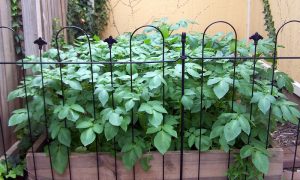 Speaking of food, and saving money on it and all – the last couple of weeks of mild weather have done wonderfully for my little patch of back yard paradise. The first embryo tomatoes were spotted this morning, and the plants are simply covered in blossoms. This might be the year that I actually have enough tomatoes to think about canning and preserving them. I followed a suggestion on another blog for making raised beds – a circular construction of chicken wire, lined with weed barrier, and filled to within ten inches of the top with leaves, which gently compost as you grow stuff in the top ten inches or so of soil. It's working pretty well so far – even better than topsy-turvey hanging planters. The raised bed full of potatoes is also thriving, and the pole beans are launching themselves up the poles with energy and enthusiasm. What a difference just over two weeks!
 Well, that is the fond nickname given to the Central Library building in downtown San Antonio – a hulking cube with geometric cut-outs, painted in a shade of dark orange which always reminded me of paprika. This last weekend, the Central Library and the campus of the Southwest School for Art and Craft across the street from it was the site for the second annual San Antonio Book Festival. This is the kind of book bash which is a small brother of the Texas Book Festival, which is huge, as far as local writers are concerned. Alas, the Texas Book Festival is so huge, that I couldn't even begin to afford an exhibitor table there, either as a writer for my own books, or as the owner of Watercress Press and for the benefit of the authors that we do publish. But I could afford a single table at the San Antonio Book Festival, so off we went, very early Saturday morning, with two tubs of books, a tub of table accoutrements, some nicely-printed flyers enlarging on what
  The rows of exhibitor tables were already set up in the parking lot of the Southwest School – three or four rows of neat white pop-up canopies, and white-topped tables with blue skirts, each neatly numbered and the exhibitor's name in larger letters. We were supposed to have help from volunteers in orange tee-shirts standing by, ready to assist, but the ones which we saw on the way in seemed mostly uncertain of what they should be doing for us; in any case, what materiel we had could be easily moved on the folding dolly. I wound up dragging it all myself, and locating our table; easily enough, since I had been sent a map of the exhibitor layout.
 Of the three Watercress authors who took a stint at the table, the first was pleased because he sold two books, the second because we made contact with a woman collecting author information with an eye to setting up events on base at Randolph AFB, and the third because I sent her over to speak to the people in the


 Once more into the breach, my friends; with
 the date of the last predicted frost in South Texas historically being in mid-March, it's time to get started with vegetables. Indeed, the local HEB began putting out vegetable starts late in February, when the temperatures became so balmy and mild that I was seriously tempted in indulge – after all, $1.00-1.25 for a four-inch pot with a healthy young plant in it? Yes, I was eager to enter the fray once again, after last years' disastrous tomato-growing debacle. It was too hot, too soon, and those plants which did manage to bear fruit ... well, the rats got to them. Not just the tomatoes, but the fresh young sprigs, and the leaves of the pepper plants as well.
 The very Sunday afternoon that I finished setting out the various starts from HEB – even as I was assembling the patent tomato cage, the cold front blew in. There I was, working in jeans and a short-sleeved shirt on a warm and muggy afternoon; we had even been running the AC, since it was so warm. Then, suddenly, I felt a cool breeze, as if the AC had suddenly kicked in outside, and within ten minutes it felt as it it had dropped fifteen degrees. We rushed the newly-planted tomato and pepper starts into the greenhouse, along with the tenderer of the potted plants, but to no avail. The water in the birdbaths was frozen hard the next morning, and the newly-planted lantanas by the walkway were pretty well frost-scorched. Even the new green leaves on the ash trees were hit. Curiously, the long containers of lettuce and salad greens by the new flower bed at the front door as well as the bulbs in it – all of which had just sprouted in the last week or so -- survived just fine, under cover of a heavy blanket. But everything else, even the pole beans which had just put up two or three leaves ... alas.
 So they are not kidding when they tell you how fast a cold front can blow in. And they also were not kidding about the last frost being in mid-March. Fortunately, I still had plenty of pole and bush bean seeds, so I've only lost a couple of weeks as far as they are concerned. And on Friday, we bustled over to Rainbow Gardens, which offered row upon row of tomato starts, plain, fancy, heirloom, large and small, early and late. I've gotten half a dozen of them into the grow box, and the rest must wait for a bag of fresh potting soil to go into the topsy-turvy planters. I'm also figuring out a way to do space-saving and self-sustaining raised beds, rather than depending on the compost bin and my vast collection of large pots. There's a kind of raised circular bed called a
 Alas, now that it was in the high 90's on Sunday afternoon, I must yield and submit to summer. Yes, it's here. Likely I will not see a cool night, and sleep with an open window and properly under the feather comforter until somewhere the far side of September. I just hope that the Deity doesn't decide to turn the temperature all the way up to broil, now that the tomatoes are lavishly in bloom, and the biggest and sturdiest of them are adorned with tiny green tomatoes, the size of pearls and grapes. Daily temps in the three digits would pretty well bake what is coming on so very, very well. Darn it, I have too good a start on the vegetable garden to be completely detached about watching it all shrivel up in the scorching heat. (Reminder; Get another jug of that insecticide – once the white-fly gets ahold of the tomatoes and beans, that's the long slow slide towards resignedly uprooting the lot and hoping to do better next year.)
 The pole beans are leaping up the poles, the tomatillo plants look to be turning into shrubs, the eggplants are burgeoning, and the very expensive cornichon gherkin seeds that I ordered from Amazon at a cost of about .17 cents a seed, plus another .15 cents shipping and handling – fourteen of them have put up sprouts. Yes, I want to make proper French Cornichon pickles this year ... but I will so let at least one of the cornichon gherkins go to seed so that I don't have to order them next year. The salad greens and lettuces are doing pretty well, too – at least, the ones that I have in pots and water every day without fail. We get a nice serving of salad greens about every two days. As for beans, I hope for enough for a side dish of them every day or so. In a spirit of resignation, I planted two packets of patty-pan squash and some kind of hot-weather zucchini in one of the wire-form raised beds. Everyone says that you are supposed to be overwhelmed with squash from a back-yard garden, but so far, I am distinctly underwhelmed. Hope springs eternal in the breast of the home gardener, though.
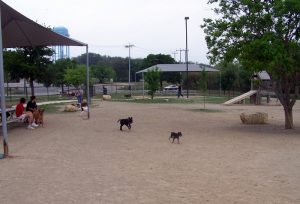 We ventured out this weekend to the
  And finally – preparations for our participation in the
  This wasn't something that we had thought about for ourselves – going to the
  The shuttle bus dropped us off right at the main gate to the carnival area – right by the big Ferris wheel, which made it easy to locate the shuttle bus stop again when we were ready to go. The fairway was pretty extensive – one of the largest that I had ever seen, with an awesome assortment of fairground rides, and by late afternoon it was jammed with families. But that wasn't the end of it; there were extensive halls of retailers of cowboy-themed stuff, Western attire and accessories of every description, from belt-buckles all the way to those fancy trailers which haul stock in the back and have living quarters in the back. Well, I had always wanted to know what the inside of those look like, having passed or been stuck behind many on the various highways around South Texas. Talk about custom and luxurious – the bathroom was so palatial, I believe I'd almost rather live in the trailer.
 We didn't get very far into the stock exhibition barns – only as far as where a handful of horses were on display, including a black Percheron named Andy, fully 18 hands and some tall, and looking to be as large as an elephant, although exceedingly mellow about being petted. My daughter was quite taken with him. Like Crocodile Dundee said of another item, "Now, THAT'S a horse!" And as a girl next to us said in awe, "His eye is as big as my brain, practically!"
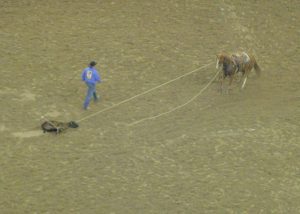 Just about all the rodeo events – that is, the ones that aren't intended for kids, like the mutton—busting and calf-wrangling – started the real world of working cattle from horseback in the 19th century. Calves and young cattle had to be lassoed and branded, and being able to do it swiftly and efficiently meant that a cowhand was good at his job. Being able to last a good few rounds on the back of a fractious horse was also a useful skill, but I am just not all that sure that staying on the back of a bucking steer was all that useful. On the other hand, life likely got pretty boring around the ranch of a winter, before social media and all.


