


Good Stuff Preserved – Sauerkraut
by Celia Hayes
 I swear, I had never really eaten sauerkraut in any form when I was growing up. Why Mom never had a go at making it herself is a bit of a mystery, since the basic ingredients are cheap and plentiful, the process pretty simple and the results quite tasty. Likely this was because our own ethnic background is English and Scots-Irish, and it's just not one of those things. Cabbage being a sturdy green vegetable and well-adapted to the frozen northern hemispheres, it's a mainstay in peasant cooking from Germany, through Eastern Europe and Russia – and even into Korea, where they make a high-octane variety spiced with garlic and hot red peppers known as kimchi. But the ordinary sauerkraut is the simplest to make at home; basically, it's thinly-sliced fresh cabbage and Ball pickling salt.
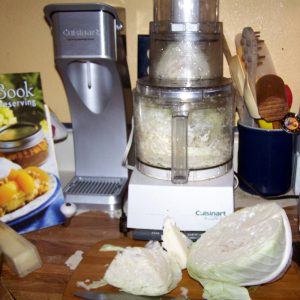 At some point a couple of years ago, we were buying a brand of pickles or marinated artichoke hearts at Sam's Club which came packaged in massive glass jars, which hold 6-quarts to two gallons. I saved out two of them to store bulk foods in, although they had to go through the dishwasher several times to entirely remove the smell of pickle brine. They're perfect for fermenting the shredded cabbage in the first step.
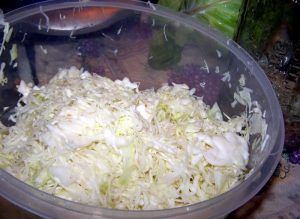
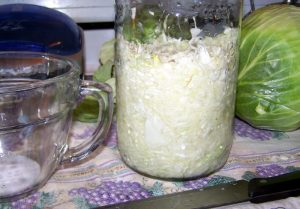 Trim of the outer leaves of four heads of cabbage, quarter the heads and cut out the solid core, then either thinly sliver the quarters, or cut into eights and run through a food processor fitted out with a slicing blade, or a mandolin – or even an old-fashioned sauerkraut slicer. It was customary back when to make massive quantities of kraut at a time – a friend of mine in Fredericksburg recently an old-fashioned 5-gallon crock which would ferment enough to feed a small army. I have a huge metal mixing bowl made for restaurant use, so the shreds of cabbage from four heads fill it rather nicely, but you may have to process it one or two heads at a time. Mix the shreds of cabbage with ¾ cup of pickling salt, kneading it gently, as the salt dissolves and the cabbage begins to give up liquid. Let sit for a few minutes and then pack it tightly into the jars until just to within an inch of the top. One of the cabbages I used this week was rather large – so the cabbage shreds filled both big jars and then a quart canning jar. One of the big jars also had two teaspoons of caraway seed added, for extra flavor.
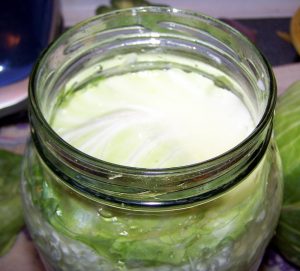 There should be enough brine from the salted cabbage to cover – if not, mix 1 ½ Tablespoons of salt in hot water, allow to cool, and top the jars with the additional brine. The cabbage has to be below the level of the brine. Another recipe I saw for this recommended cutting a cabbage leaf to size, and using it as a topper, to keep the cabbage shreds underneath – or just use a smaller jar filled with weights to keep the cabbage submerged. Cover the tops of the jars with cheesecloth held on with a rubber band, and let sit and ferment in a sheltered cupboard for 3-6 weeks, removing the scum which forms every day or so. When it's ready, either refrigerate it and eat fresh, or empty the sauerkraut into a big pan and bring to a gentle simmer – not a boil. Pack it into clean hot canning jars, leaving about half an inch of head-space, seal and process in boiling water; 15 minutes for pint jars, 20 for quarts. We have finally finished off the sauerkraut that I did last summer – so time to pickle again!
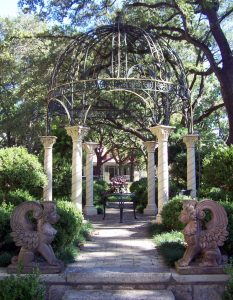 We walked through the part of the Riverwalk which runs from the Blue Star Art Complex up through King William last weekend, marveling at all the lovely period houses lining quiet, tree-lined streets. Although right next door to each other and very nearly of the same vintage, King William and Southtown have completely different sensibilities. The old Southtown houses are smaller, closer together, and many of them are more given over to commercial and artistic enterprises. While
 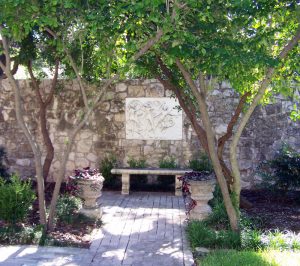 The area was San Antonio's first extensive up-scale suburb, beginning around the mid-19th century, when well-to-do German merchants and industrialists like C.H. Guenther, of the Pioneer Flour Mill began building stately mansions on what had been the outlaying farmlands attached to Mission San Antonio de Valero and Mission Conception. That first glorious heyday lasted until well into the 1920s, when the well-to-do began being drawn into newer developments in Alamo Heights and Terrell Hills, on rising land to the north of downtown. Many of the stately mansions became boarding houses, or broken up into apartments, and the area gently – or precipitously –decayed.
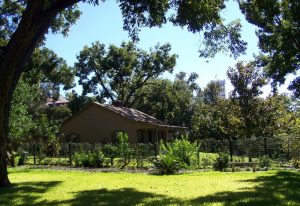 The credit for reviving the neighborhood and kick-starting restoration of many of the historic mansions and residences is usually given to Walter Mathis; a descendent of several local notables, including John W. Smith, last messenger from the Alamo and later Mayor of San Antonio. After service as an Army Air Corps combat pilot during WWII, he turned to investment banking, civic good works and collecting art and memorabilia. Late in the 1960s, he bought the house presently known as the Villa Finale and spent several years in research and meticulous repair; a splendid Italianate pile with a three-story square tower at one side. He filled the house with fine furniture, art and the results of his own enthusiastic collecting, lovingly landscaped the grounds ... and then turned to other houses in the neighborhood, purchasing at least fourteen other houses and either restoring them entirely or in part, before re-selling – often on very favorable terms – to friends and acquaintances who could carry on the restoration. His efforts kick-started establishment of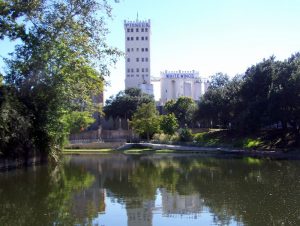
 We had reason to go downtown the weekend before last; we were baffled of our intent to park in the big lot opposite the federal building on Durango/Cesar Chavez. It is most usually free and only a short walk into Exposition Park, the Alamo Plaza and La Villita from there, but the beer festival in Exposition Park baffled us of that intent, and so we parked in the structure at Commerce and North Presa. At $12 for three hours we decided to make a day of it, and do something daring and reckless so that my daughter could cross it off her bucket list. She has always wanted to go in and eat at Schilo's Delicatessen, but every time before, we were defeated by a wait for a table 45 minutes long, or a tight schedule, or something. We had often looked longingly into the amazing period interior; yes, this is what these old turn-of-the-last century places looked like; tall ceiling (covered with stamped tin) high windows, a multi-colored tile floor made of those nickel-sized hexagonal tiles, old wooden pastry cases and booths with a hat-and-coat hook on the end of every bench. There was a time when every chop-house, delicatessen or restaurant looked just like this.
 We had our chance this last Saturday;
 Walking it off – that meant a meander along the Riverwalk. This time, we parked at the Blue Star Arts complex and walked back towards King William. The cool fall weather was just perfect for this excursion; not a cloud in the sky, the grass still summer-green, and those trees given to dropping leaves not dropping them as yet. I am still marveling at how close everything actually is in San Antonio, and how very close a residential neighborhood can be to an industrial one – like the Pioneer Flour mill is to King William. My daughter loves the old Victorian cottages and mansions, although we could neither of us afford to live in one yet – and I am not quite certain that I would want to, knowing what I know about antique plumbing, peculiarities of electrification and nonexistent HVAC systems. I suppose the ideal solution would be a modern house with all of that, but built to 19th century plans. We did see one house under construction where this was being tried, but it didn't look quite right to us. The porches weren't deep enough, and the windows and porch columns themselves weren't quite there. And that was my weekend – yours?


 It's one of my habits – established when we lived in Athens in the early 1980s – going to the local street or farmer's market. It was the custom of the country that every neighborhood had a day of the week, when a three or four-block length of one of the main streets in the suburb would be blocked off, and the local vendors and farmers would set up two rows of booths and sell to the community, beginning just before dawn and continuing through midday. It was usually seasonal fruits and vegetables, and each little booth pretty much specialized in one item – lemons, or artichokes on long stalks, or potatoes with patches of the damp soil they had been grown in still clinging to them. There was an egg-vendor, who sold the eggs in cones made up of newspaper, and a storekeeper with a larger trailer who had a variety of dried beans and macaroni, and often a crate of live snails, rustling and clicking their shells together. All was absolutely fresh, straight from the farm and cheaper than cheap.
 I've always hoped that our farmer's markets here could duplicate that experience; and the goods are fresh and straight from the farm, but alas, not as inexpensive as they were in Greece. The farmer's markets here do have their advantages though; the one held every Sunday morning save Easter in the parking lot of the Quarry Market is a perfect example; as half the venders seem to do the traditional fruits and vegetables, the other half a wide assortment of prepared gourmet foods. [Curious though, I didn't find the Quarry Market on the
 We cruised the two rows of booths – threatened rain didn't seem to hamper turnout at all, though there were some vendors on the
 The final booth that we visited was – I think – the Lemonade Company, purveyors of fresh-squeezed lemonade and orange juice. The scent of the oranges teased me from three booths away. There is nothing so evocative to someone who grew up in Southern California as the scent of fresh oranges and lemons – and the sublime flavor of the juice freshly squeezed. Nothing like it in the world, and it has spoiled me ever since for supermarket orange juice. And that was my Sunday morning – yours?

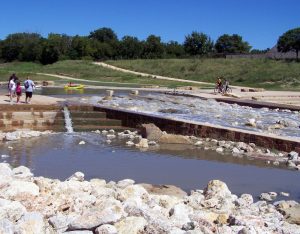
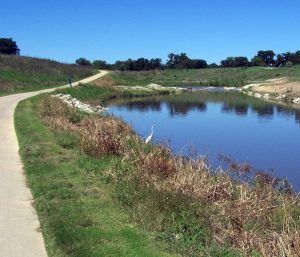

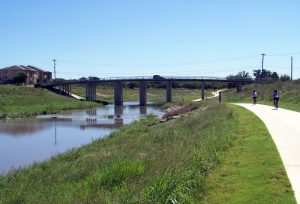
 But the Riverwalk extension to the north – the Museum Reach has now gone almost as far as Breckenridge Park. Some time ago we walked it from the Pearl Brewery well into downtown – and this last weekend we hiked a length of the new Mission Reach, between the Riverside Golf Course and Padre Park. It had just opened with some ceremony and celebration the day before, but Saturday was hot and presumably crowded, and Sunday was not. We went venturing, armed with a map of the new reach and were most pleasantly surprised. The Riverside Golf Course is most astonishingly upscale, green and manicured. All the new park pavilions along the way were newer than brand spanking new, the finished trail was wide and beautifully finished, every turn of the trail with a pleasing aspect was furnished with an assortment of benches and picnic tables positioned for best effect. There are not so many trees shading the path, though – although there are some groves of tall pecan trees off on either side. The pecan trees along the river provided sustenance to the Indians from the earliest days; I wish there were more of them, but as one of the ladies whom we talked to said – it's still a work in progress.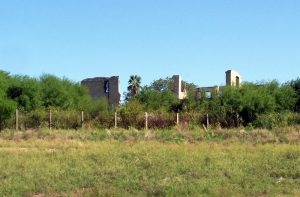
 It is all very new, though – and although there were enough people venturing on it – by foot, bicycle and kayak, there were not as many as we thought would have been there if the Mission Reach was more well-known, and if the various establishments on either side were more orientated towards it. If this was Europe, my daughter ventured – there would have been families picnicking at every table, and children playing on the various greenswards. Men would have been trying their luck at fishing in the river – and contra the warning signs here and there, there would have been people swimming and wading in it. There would have been ice cream vendors on bicycles towing little coolers after them, selling cold drinks and ice cream cones to all. Commercial establishments with an eye towards the view would have had outdoor dining areas looking toward the riverbanks – and those people sufficiently fortunate to have houses with back yards overlooking it would be building their gardens with an eye towards the view. A couple of mobile home parks that we spotted would also have made their Riverwalk-Mission Reach location a major feature of their appeal. Very likely the rejuvenation of the old Hot Wells Resort will play into this. The old tourist cabins on the ground – overgrown in thickets of small trees – are as ruinous as ever, but looking through the fence at the edge of the main property, we could see that work is being done. There is even a new roof on part of the old bathhouse building.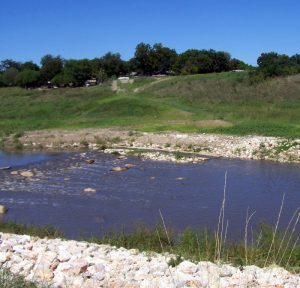

 A good few years ago I had a project for a college class in ecology, a topic that I already knew a good bit about, thanks to Dad. Yea, my bretheren and sisteren, at that time, the whole concept of ecology was a brand new and shiny one, with that nice fresh concept smell to it. Dad, being the working research biologist, had introduced us it ages before – when we were in grade school, as a matter of fact. My class project involved finding out about nominally wild animals living in the city. In that pre-internet and search-engine day this involved a daisy chain of phone calls, beginning with the city animal control office, until I wound up talking to (IIRC) a gentlemen at the Bureau of Land Management, who kept saying that really, he didn't know all that much about it, but talked for nearly an hour telling me of all kinds of examples and incidents involving wild animals settling down rather happily in suburbia, and even deep in city high-rises.
 At the time, we lived in the hills, on the far fringes of a suburb nestled against a national forest; miles and miles of chaparral-covered hills and semi-dry creeks, so that we were already acquainted with coyotes and foxes, and once we had even found the tracks of a mountain lion, deep in the canyon on the muddy bank of a creek. I thought that I had left that kind of untrammeled wild-life far behind upon moving into a fairly built-up suburb in San Antonio, but no... there is plenty of wildlife, happily roaming in or flying over the neighborhoods.
 There are enough fingers of woodland along the creeks and parks connecting them to support quantities of deer. In Hollywood Park the resident deer herd is seen as sort of community pet and the main campus of USAA also supports their own herd. The only surprising thing is that there are no apex predators preying on the deer save automobiles ... yet, anyway. A couple of years ago one of my neighbors nailed a deer with his car, on Nacogdoches between Judson and O'Connor. The deer was killed – so was his radiator. I presume that there are coyotes and foxes prowling some of the denser thickets, although I have not seen or heard any – and believe me, although coyotes may be shy, they are not quiet.
 The suburban critters that I have seen – and sometimes up close and personal are possums and raccoons. Just this very week I have had a young raccoon removed from where it had been making a messy nest under the eaves of the back porch. One morning when I came out to get the newspaper, I surprised some skunk kittens on my front porch. A neighbor had just demolished the deck at the back of her house, evicting them. I had a family of opossum kittens living in my garden for a while; four of them, who seemed to like the cat food that I put out for the timid semi-feral cat that I was trying to tame. I was eventually successful with the cat, but not the opossums.
 Birds now – egrets in the creek bottomlands, rails and ducks in plenty, and wherever squirrels are in plenty, there will be hawks. There are several nesting pairs in my neighborhood alone, performing the office of chlorine in the squirrel gene pool – in two instances, sitting in the mulberry tree in the back yard, chowing down a nice bit of tender squirrel al la plein air. The wild kingdom is all around us, even in the middle of the city.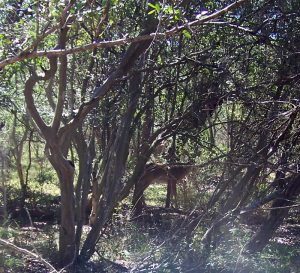

 With the sale of the acreage in California coming down the home stretch in escrow, we have been considering what to do with the money from the sale of the land. Oh, a certain amount will be plowed back into the purchase of a Hill County Lot of half acre to an acre, but the immediate need is to spend about half of it on the current house. It was originally built by Centex around 1985, but all the components in it were construction grade and purchased by the warehouse-load. The light fixtures and fittings, the carpeting, linoleum, cabinets and countertops, sinks and toilets, the doors and windows, the installed appliances, the HVAC systems ... all were pretty much uniform. Over the years, many of our neighbors have replaced certain elements, which we have recognized as they were put out for the bulk trash pick-up or to be taken away by the renovators.
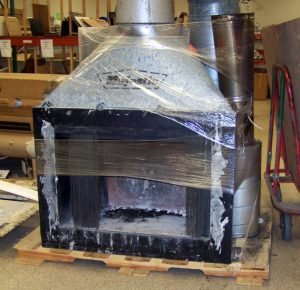 I ripped out the carpeting in our house myself, long since, and replaced just about all of the light fixtures, but other more serious replacements and upgrades have had to wait until now. While waiting for escrow to close, we were not sitting around twiddling our thumbs. We were auditioning contractors to replace the HVAC system, and the windows. Those two were the most critical needs; critical because the CPS bill has been climbing insidiously upwards over the last few years. The original system was – as the maintenance company told me for many years – the wrong size, badly situated, and indifferently-installed. When extremely cold in the winter and hot in the summer, my daughter preferred to sleep in the den, since her bedroom was so uncomfortable. As for the windows – aluminum-framed double-paned and screens with frames so flimsy they bent if you looked at them cross-eyed – any trace of argon gas between the glass panes was a distant memory.
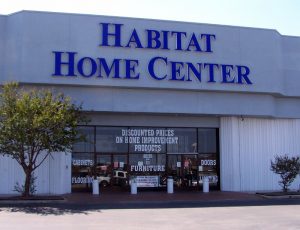
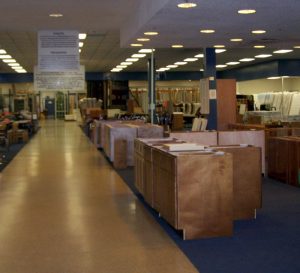 The HVAC contractor was an easy choice; we really only considered one, which had done such a bang-up job for a neighbor that he has been singing their praises ever since. He got a rebate on his CPS bill which has been good for months – that was the kind of thing that we are passionately interested in. What I would have paid to CPS will go into replacing the windows, which should cut down that bill even more. As for other projects – countertops, cabinets and floors, that may have to be done piecemeal, although we have a darned good chance of picking out some bargains at the
 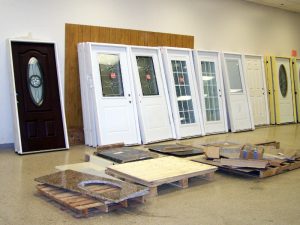 We were there last weekend, scoping out cabinets and front doors, mostly. The Home Center is stocked with donations – both builder/construction surplus and donations from homeowners doing remodels. They even offer a tear-out service; they will come and take out old cabinets and countertops, without damaging them – and well, we approve of recycling, especially if it is good quality to start with. The one project we considered tackling ourselves, or with the help of a friend who does minor construction, is replacing the front door. The sealing around the door has degraded about as much as the windows. We spotted some exterior doors at the Home Center which would work very, very well ... and even with paying the friend to help install the darned thing, it still would be less than the cost of doing it at Lowe's. Hmm ... calk, nails, a level, screwdriver, tape-measure. Doable, definitely.