


The Draw of Downtown
By Celia Hayes

 Now and again we are drawn downtown – usually not when there is a mass event involving crowds of people, expensive parking and temperatures of 90 degrees and above – but for purposes of our own, often involving visiting friends and relations, book research, or just plain curiosity. On these occasions we are reminded again of what a lovely civic jewel the Riverwalk is, even though I am certain that the noise and congestion would become tiresome for those living or working in one of the buildings overlooking it ... but still. Green water, fringed with immensely tall feather-leaved cypress trees and narrow gardens, stone walkways, little bridges and ornaments of civic art in tile, metal and stone. It is a marvel and I do not grudge a penny of my taxes which helps to maintain, support and enlarges it, yea even to the north as far as Breckenridge Park and to the south as far as Mission Espada. Let all be adorned and improved, let the gardens and fountains be extended, ancient and not-so-ancient structures be repaired and repurposed, to the greater glory of our fair city. It brings in tourists and conventions, after all – as well as the creative, the enterprising, the trendy and artistic – and as the Riverwalk is extended, brings even more of it to those of us who live here.
 But this last Labor Day, I had a curiosity about the arts and crafts show which was supposed to be arrayed along the banks of the Riverwalk adjacent to the Chamber of Commerce. Of course, by the time that we drifted in from parking around the corner from Main Plaza and walking from there, a fair number of the arts and crafts vendors had departed. It was
 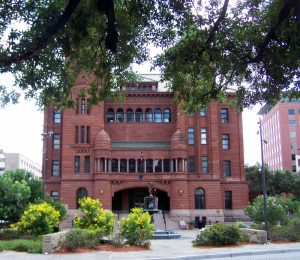 y, it was hot, the crowds were thin and the next day was a regular work and school day, so I wasn't the least surprised.
We parked near Main Plaza and walked through it on the way to the stair down to the Riverwalk. This was a project of a former mayor to make the Main Plaza a more park-like and pedestrian-friendly place than it was when I moved here in 1995. Then, if I recall correctly from calls for jury duty, it was a mean and isolated little patch of discouraged grass, a statue of St. Anthony, and a stand of oak trees, isolated by four very busy streets – Soledad, Main, Commerce and Dolorosa on each of it's four sides. Hizzhonor's original plan was to cut off all four streets and divert local downtown traffic who-knows-elsewhere. He was discouraged in this by the screams of local businesses and commuters, although it just may have been a bargaining chip. In the end, only Soledad and Main were pinched off. Now the sweep of the old square in front of San Fernando is adorned by ornamental paving, fountains, trees, a couple of kiosks, moveable chairs and tables in the European style, and very few aggressive homeless.
 We wandered briskly along, stopping to admire a number of dogs downtown with their persons in tow, and wondered if we should bring our own next time. Eh – maybe. Of the artists remaining, one which drew our rapt attention was one featuring silver and larimar stone jewelry. Larimar is, according to the vendor behind the table, a unique volcanic stone, rather glasslike and several shades lighter blue than turquoise. It only comes from one little mine in the Dominican Republic. Then there was an artist whom my daughter had been looking for, ever since spotting the art at a First Friday several months ago, and never seen since. So – all to the best was this trip downtown. We emerged back into Main Plaza somewhat dehydrated but triumphant. That was my weekend – yours?


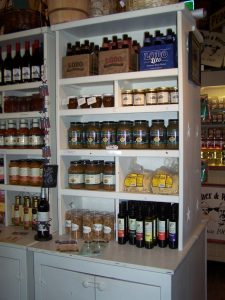
 So, I came to San Antonio for my final tour of Air Force duty in 1995 – but I think it took a little while for me to discover Fredericksburg, and the lovely, tasty specialty food products put out by Fischer and Wieser, of Fredericksburg in the Hill Country. It is in my mind that for the first couple of years, Fredericksburg was the only place that you could buy them anyway. Certainly all the little gourmet food outlets along Main Street had a good selection of
  Looking at the company website, it appears that was about the time that Case Fischer developed the Roasted Raspberry Chipotle sauce, which in movie parlance, was a tiny little local biasness's First Big Break. Roasted Raspberry Chipotle is magnificent, by the way, but at first it must have seemed to be one of the weirdest concoctions ever proposed. Smoked Mexican chipotle peppers ... and runny raspberry jam? Together? Hoooo-kay... But it put Fischer & Wieser – and chipotle peppers on the map. (For my money, the best thing on grilled shrimp is the ginger-habanero sauce, though. After driving past Das Peach Haus every time we came in to Fredericksburg by the road from Comfort – we finally stopped and went inside, and realized that – oh, my, it is bigger than it looks! There are little patches of landscaped garden all around, shaded by a grove of pine trees. And there are resident cats, too – always a good indication of quality, no matter if the product is books, garden stuff ... or gourmet foods.
 But the peach orchard which was the genesis of the company has been around since the Wieser family bought the property in the 1920s, and their son Mark opened a roadside fruit stand in 1969. There are a lot of seasonal roadside fruit stands on the main roads leading to Fredericksburg, and the Peach Haus was just one of them. The family sold fresh peaches, of course, and home-made peach preserves. Mark Wieser also taught school – and one of his students often helped out at peach harvesting time. Case Fischer was so keen on the possibilities of a specialty-food, development, marketing and entrepreneurship, that he went off to college and studied all that ... and when he came home to Fredericksburg, he teamed up with his old teacher, and set about innovating, creating and producing quality foods; sauces for meats and pastas, mustards, jams and preserves, pie filling, salad dressing and dips.
 And instead of just keeping it a local thing, Fischer & Wieser went national. Within a couple of years, I didn't have to make the long drive up to Fredericksburg for some Roasted Raspberry Chipotle Sauce – it and other products were on the shelves at the local HEB – even my own local, which usually is a little light on the gourmet goods. Even better – they are available in military commissaries and on Amazon.com. Not bad for a tiny local enterprise which started as a roadside fruit stand. Yes, indeedy – they did build that business.

 It's just one of those things – Texas should be so large a state as to have not one, but several different regional variants in barbeque stylings. Yes, in less-blessed climes, barbeque is done by just throwing your choice of animal flesh on the grill on the back porch and allowing it to char slowly over the coals or (byte ones tongue) propane flame. I have even run across *shudder* recipes for marinated and grilled slabs of tofu.
 Sorry – barbeque here means mainly beef, although pork, turkey, chicken, sausages, and even cabrito – or goat and mutton – makes an appearance in the borderland Hispanic variant of barbecoa. There is the east Texas variant; marinated beef cooked slowly over hickory wood until the meat falls from the bone and served with a thick, tomato-based sauce, the central Texas option; beef or other meats rubbed with spices and cooked slowly over pecan or oak wood, and the south Texas style which features cooking over mesquite – an acquired taste. South Texas style preference is for a thick sauce and moist meat. A great many of the old established independent barbeque places began as meat markets, where the butcher – in the days before deep-freeze refrigeration – thriftily began to smoke and slow-cook all those leftover or unsellable bits at the end of the day, providing them as ready-to-eat morsels the next day. Waste not, want not, as the saying goes.
 Frankly, to me, it's all good, no matter what variant and the selection of commercial sauces available at the local HEB will prove that we love it here, either D-I-Y or from the local maestro of the pit. In the main, people here have high standards when it comes to making barbeque themselves, and adamant concerning the virtues of all those places which provide it; from chains like Bill Miller with outlets everywhere, through enormous single-standing locations like the Kreus Market in Lockhart, and then there are tiny and often locally famous places – like the Riverside Meat Market in Boerne (cunningly disguised as a meat market in the back of a corner Shell gas station) – and even the peripatetic Smoke Shack, a food truck which is usually, but not always to be found just inside the 410 Loop at Nacogdoches, parked in what used to be a gas station. Aficionados will drive any number of miles to sample the glories of an independent barbeque outlet ... and many other aficionados will also pay interestingly substantial amounts for grills and smokers of every description, although I will note that to the hard-core, propane is frowned upon. It's all in the wood and cooking it long and slow, in the flavored smoke. For a while, I had one of those inexpensive barrel-shaped cylindrical smoker-griller things, which did an amazing job for the price – save that I had to cook a huge lot at a time, which was only cost-effective if I was expecting to feed a small army on hickory-smoked chicken.
 These days, I have to cheat, with my daughter's propane grill from Lowe's – which does the job – and I suspect that if I tinkered with it a bit, and figured out a way to put in a pan of soggy wood-chips and keep the heat really, really low – I might have some decently-flavored barbeque.
 I can't say that I was very surprised to find out from various online sources last week that Texas is pumping so much oil from the Eagle Ford Shale formation in South Texas (among other oil-rich shale formations, some of which are not quite as well-along as far as drilling goes) that if it were an independent country, it would be one of the top fifteen oil producers. I am not one who follows this kind of thing, religiously – although where I grew up in Southern California, I remember seeing many a small rocking-horse pumpjacks scattered here and there, nodding busily away in the bean-fields and citrus orchards in Camarillo, or along the highways and back roads. It was just one of those things in the background. I don't know if there are many pumpjacks left in So-Cal now. Probably not, although they are at least as unlovely as wind turbines and probably don't kill nearly as many birds. I lament the loss of the place where I grew up, by the way; a place of citrus groves, and lonely hills, a rural, blue-collar and working-class kind of place, where you could drive in a single afternoon from a palm-tree desert to a pine tree covered mountain-top frosted in snow. Alas, it seems that the wealthy coastal enclaves drive California now, to the ruination of the places which I remember so fondly.
 So we had noted some ... well, some outdoor works of art, arranged in a landscaped space on River Road next to the Ewe and Eye yarns and handicrafts establishment, and last week we stopped for a few minutes to check it out up close. It's the Texas
 So many yards of metal squares, set together ... and yep, that's just what it looks like from the air; mostly flat, a little rolling, with depressions that collect rainwater in season, moving up into a range of peaks on the far horizon, neatly crossed by a regular grid of roads and fences. It's a modern piece, which I usually don't care for at all, but it is strangely appealing, and outdoors is just the place for it. Presumably the whole place is under camera surveillance, 24-7, and since shoplifting any of the pieces would involve a heavy-duty winch, welding gear, a reinforced vehicle and a couple of hours work – they're probably pretty secure.
 So, contra the belief that the wild and crazy art scene is all in Austin, and there is nothing much in San Antonio save the military bases, medical centers and the Alamo ... there is an art scene, an
 To backtrack a little; my daughter and Edith, her best friend from high school (St. Francis Academy, Class of 1998) having despaired of ever finding full-time, well-paid and remunerative employment doing something rewarding – or at least, something they do not hate – have decided to go into business together. Edith is an artist in pastels, and quite gifted. My daughter is madly creative with origami, the art of folding paper into astonishing and ornamental shapes – including tiny crane and tulip earrings – and all sorts of other charming ephemera. As I told Edith, when she was worrying about being seen as a sell-out by trying to make a living from her painting, there is a word for someone with a gift who just plays around with it and never tries to get back expenses. That word is 'hobbyist.' And someone who creates art, shares it with the world at a fair market value – whatever that value might be – the word for that person is 'professional.' I wouldn't want to see her go as far into monetizing and mass-producing her paintings like Thomas Kinkade The Painter of Light ™ did – but the guy did manage to make a very good living from it, and I wouldn't mind seeing my daughter and Edith meeting a market demand.
 So, I have urged them both to try and start making a living doing what they love to do; starting small, of course – working the website (
 They hope to be included in the Guadalupe Cultural Arts Center's Hecho A Mano/Made by Hand this fall, and to have a vendor table at couple of local Christmas markets in November and December. In the mean time, they'll be at various First Friday events in Southtown, and Second Friday at Tobin Hill ... and who knows? They just might be as popular as Thomas Kinkade.
 Well, strictly speaking, the Steves Homestead isn't what you'd really think of on hearing it called a homestead. It's more of a splendidly ornate, Second Empire French mansion, with a slightly in-curved mansard roof topped with a spiky crown of iron lace. It's one of the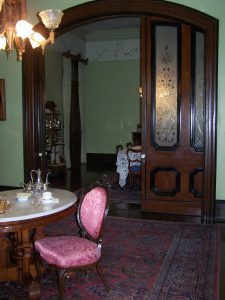
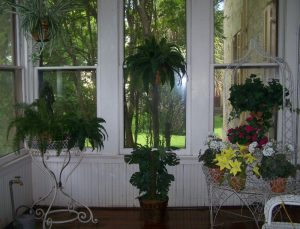
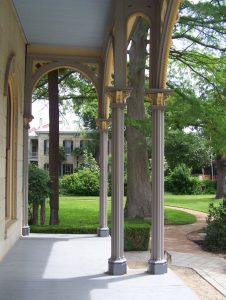 Oddly enough, although the house looks huge from the street – it is actually rather manageable on the inside; the main floor is a block of four rooms and a stair hall down the middle, with a little conservatory built out on one side, and a range housing the kitchen and servant's quarters out at the back. The rooms are comfortable and airy, with high ceilings and tall windows shaded by mature trees; just so rooms had to be in the days before air conditioning. Many of the furnishings were bought new for the house by Joanna Steves; she kept only a very ornate hall tree made in New Braunfels from the previous house. Some of the art and furnishings came from Europe – one of the most spectacular is a circular table in the formal parlor with a micro-mosaic inlaid top featuring views of Ancient Rome which look like incredibly detailed paintings. The various roundels have large magnifying glasses laid out on them so that visitors can look and marvel at what was made with mosaic tiles hardly the size of the head of a pin.
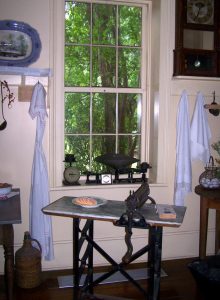
 Mr. Steves had a home office – with a separate entrance at the side of the house, and in back of the formal parlor. On the other side of the hallway was the informal parlor, with the dining room in back of that. The kitchen was around a short dog-leg corridor – to baffle the heat of the stove and the smells of food preparation – and everything is furnished with bits and pieces, just as it would have been ... or if not as it would have been, as close as it is possible to get. At least a hundred years separate the Steves mansion from the Spanish Governors' Palace – and the difference between them is most noted in the kitchen; a huge iron stove served the Steves' cook, while the old Spanish establishment made do with something that looks rather more like a wood-fired pizza oven.
 Out in the back, and on the riverbank behind the house is another curiosity – an indoor swimming pool. This is supposed to have been the first ever in San Antonio; Joanna Steves went swimming in it every day on the dot of 2 PM. This recalled to me the observation of urban garden planner and writer Frederick Law Ohmstead, who had visited San Antonio in 1855 – and noted that all the very best houses had gardens which ran down to the river, and the residents spent many happy hours in the hot summertime bathing and swimming in the cool water. Well, that was the only way they had to beat the summer heat then, wasn't it? The Steves homestead, and the neighboring streets in King William and Southtown are well worth a visit.