


The Spanish Governor's Palace
by Celia Hayes

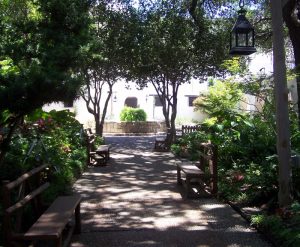 The single-story adobe ramble on the corner of Military Plaza (or that which is left, with Town Hall plunked down in the middle of it) is the oldest existing domestic structure in San Antonio, It dates from the 1700s; that period when Texas was a far-flung outpost of Spain, and the entire town was a huddle of similar houses around the margins of Military and Main Plazas. So – the Spanish part of the description is justified. It definitely wasn't a palace by any stretch of the imagination. But it was a vast improvement, living-situation-wise over a windowless, dirt-floored jacale-hut made by planting upright timbers in a trench and plastering them inside and out with mud, so on that basis it certainly looked enough like a palace to warrant a touch of exaggeration. Finally, it was a governor's residence only by extending the term to gossamer-thinness; it was originally built as the residence and place of business for whomever was captain of the local garrison.
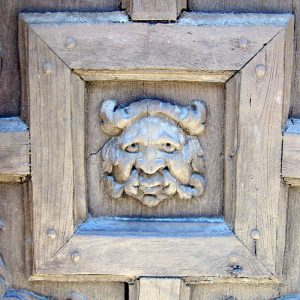
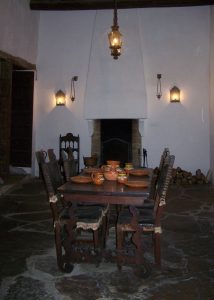 That captain of the garrison was the highest authority-figure around, year in and year out ... and long after Mexico won independence from Spain, and Texas won independence from Mexico, the sturdy adobe building survived, as the home of the family of the last garrison captain. When it was no longer a residence – as the area around became a lively commercial district – the rooms housed various enterprises; a pawn shop, a grocery store, a couple of saloons and a haberdashers. Little by little, similar colonial-era structures crumbled, or were demolished and replaced by newer and bigger shops and houses. The nearby Veramendi mansion on Soledad, from the same era and general plan, but built of stone, also followed the same arc. Once the home of the aristocratic family whose daughter married James Bowie, it descending from a grand residence to a variety of shabby businesses before being demolished in the first decade of the 20th century in order to facilitate the widening of Soledad Street.
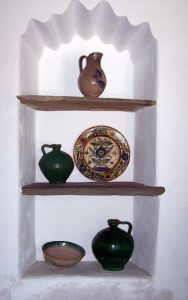
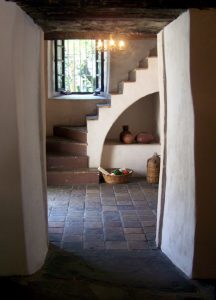 The Governor's Palace was luckier – in that it didn't stand in the way of any plans to widen streets, and that the conservation bug had settled in, well and truly. The city bought the place entire, and commissioned architect Harvey Partridge Smith to restore it to what it would have been like in its glory days. Smith used his knowledge of other similar buildings across the length and breadth of the Hispanic settlements in the Southwest, and so arrived at a romantic approximation rather than a strict interpretation. But it is a charming building even so, with thick walls and tall ceilings (as a sort of heat sink), long narrow windows opening into a Spanish-style courtyard and garden. In the old days, the garden and outbuildings would have reached to San Pedro Creek. The floors are of tile, which would have been cool to walk on, and there are numerous niches cut into the walls and set with shelves for various ornamental items. Before the invention of air conditioning, this kind of building would have been about as comfortable as you could get, in the heat of a Texas summer. The Spanish Governor's Palace is open to the public various hours on every day but Monday, and is well worth a visit to gain an idea of how the upper elite would have lived in early San Antonio.
 I have to say that the occasional rain shower over the last week or so has been very, very, very welcome, and so have the cool fronts. Anything which delays the full frontal blast of wicked summer heat by a week or so is a good thing in my book. But it has been a good month in the garden; what a difference a mere four or five weeks have made.
 This year, I bit the bullet – the only plant starts that I bought were tomatoes. They went into a pair of Earth Boxes, and six home-made hanging planters. So far, lots of big green tomatoes, but nothing edible yet. For just about all the other plants this year, I began with packets of seeds from Lowe's; three or four kinds of beans, sugar peas, three kinds of squash, and five seed potatoes from Rainbow Gardens. The bell, jalapeno and cayenne pepper plants are left over from previous years, as are the eggplants. I had never really thought of them all as perennials, but they all came back very nicely from winter.
 The pepper plants are thriving, and the eggplants all have fresh new foliage and are hung with star-shaped purple blossoms which herald fat little eggplants, or so I hope. The okra plants began from seeds from last years' okra plants. I didn't know that you have to pick the okra pods as soon as they are about four or five inches long; any bigger than that, and they are totally inedible. So, I had a boat-load of okra seeds. Until now I had never had much luck growing vegetables from seeds. Very likely, I was doing it all wrong in trying to cultivate the terrible, horrible, awful clay soil that my yard is made of. Even digging in sand and compost didn't help much. Last year we used Scott's Moisture Control Potting mix in the pots and Earth Boxes, and things generally did very well. This year we filled the two raised beds with it, planted squash and potatoes in one, and beans in the other, crossed our fingers and hoped for the best.
 The squash have begun putting out blossoms; it looks like the little green patty-pan squash are going first, with the yellow squash and the zucchini lagging slightly behind. The beans – the Kentucky Wonder variety began going up the string net which I had run from the edge of the raised bed to the top of the fence as if there had been some green bean drill instructor screaming at them to climb. As of this week they are covered in little white and purple flowers. These things are supposed to bear copious quantities of beans – and harvesting them regularly encourages even more. I still have packets of other varieties of beans, and hope to start another couple of small raised beds. It seems that I have inadvertently hit on the right place in my garden to grow pole beans; partly shaded for much of the day, but growing up against a south-facing fence.
 Given a nice big lot, spectacular situation, mature trees, an architect-designed mansion, and massive infusions of money, it's practically a no-brainer that there will be a beautiful garden, or even a merely adequate or maybe just a functional one adorning it all. What is really a challenge for a hard-core gardener is to create a lovely garden on a tiny lot, in a fairly ordinary suburb of small and relatively plain houses ... and on a budget. Sounds impossible, but it has been done by at least three homeowners in my very own neighborhood of
 But the second spectacular garden that I know of has been established on an even tinier lot – and the best of it isn't even visible from the street. You'd never know, just by looking – although the fact that the front lawn and the single well-manicured flower bed in it would likely give a clue. The house is one of those very like mine; a narrow rectangular cottage built close to the property line on one side, with the garage at the front. There is a gate into the long and skinny side yard, which leads to the front door – which isn't actually at the front, being that it is in the middle of the long side. A lot of the smaller houses in Spring Creek Forest were built like that, which means that at worst, the windows along that side offer a splendid view of the long blank wall of your next-door neighbor's house, at a distance of about fifteen feet or so.
 Not this house, though – a number of small ornamental trees planted by the original owner masked that unenticing prospect. The original owner also had a screened back porch installed at the back of the house – which was one of the main reasons that Bess and James bought the place as their retirement home about two years ago. They loved the screened porch, and the tiny yard that it overlooked. The house had one more advantage; some very tall trees in neighboring yards provide shade in the afternoon; a good thing, especially at the height of summer. And because of the slight grade present, none of the neighboring houses windows overlook that patch of pocket paradise.
 One of the first things that Bess and James did was to tear out a wooden deck and gazebo along the side, and replace it with a walkway of flagstones set into decomposed granite gravel. There are several benches and chairs along that skinny side garden; it feels larger than it really is. The screened porch looks out on the back yard, and another paved area, shaded with a fig tree. Bess has many flowering plants in pots lining the walkway. They do have hopes of a small patch of healthy lawn – but near-constant shade makes it iffy. And almost the best part is that nothing planted in it is particularly exotic or high-maintenance; in fact, Beth laughs, because just about all of it came from Lowe's.
 I have to admit that I have been driving past the Texas Transportation Museum ever since I moved to this city (ulp) nearly twenty years ago and discovered that Wetmore Road was an especially speedy means of getting from my home in the north-east quadrant to the area around the airport. I was just not sufficiently motivated to stop in and check it out – which since it is only open on Friday and weekends, and I was usually driving past during the week ... well, I had no particular reason to visit until this weekend. I am currently scribbling the first draft of another historical novel set in Texas, this one in 1876-78, and with a large portion of it set in San Antonio. Those years were significant, for a couple of different reasons.
 The United States celebrated the Centennial in 1876 – a whole hundred years as a nation, which at times had seemed like being a pretty close-run thing. The long and brutal Indian wars with the Comanche, the Kiowa, and the Apache had been briskly wrapped up, making large tracts of western land safe for settlement, the Civil War was eleven years in the past, although it would not be forgotten – and most importantly for San Antonio; it was finally connected to a railroad – the last large city of any size, east or west, to do so.
 This led to a local boom in business and in transport, much of which is documented on the Transportation Museum website. In the bare space of those years, a bustling new neighborhood grew up around San Antonio's first rail terminal, somewhat to the north of then-downtown. It was known as the Levee, for the way in which the tracks had to be laid on a strip of artificially built-up ground – just about where IH-35 cuts through Milam and Sherman Streets. The original terminal building is so long-gone that only a couple of pictures exist of it, as it was. But the railroad depot was also the impetus for a mule-drawn streetcar system, and very soon those streetcar lines formed a network ... and the sleepy adobe-built frontier village was subsumed.
 There are two birds-eye city maps of San Antonio, the first from the early 1870s, in which San Antonio is mostly green space and wide tan avenues surrounding a thicker cluster of buildings around Commerce, the twin plazas and Soledad, all tangled about with the blue-green ribbon of the river. In the second, from the 1880s, the railroad has arrived; the network of streets, all tightly packed with businesses and houses has spread and spread again, reaching nearly to the parade ground and the Quadrangle at Fort Sam. And it was the railroad arriving, which made all that difference.
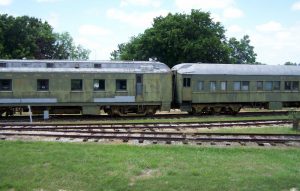
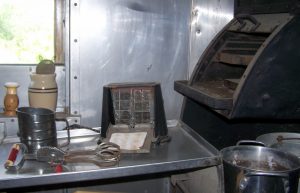 The Transportation Museum documents much of that on their website – almost more thoroughly than in their current displays. The museum is entirely run by unpaid volunteers, and I would guess on a shoe-string budget. There are some neat old rail cars on display in the open air – gosh, that was the way to travel, back in the day, in a Pullman car, with nice little beds that pulled out, or down for the night, and with a restroom-lounge where one could change...There is also a large barn with more historical cars and carriages on display, as well as a huge model railway set-up. It's all very much a work in progress, and candidly not a threat to the California Railway Museum in Sacramento ... but then, California has other problems of its' own. Still, it's a great place for an hour or so, especially for kids, who would never have seen rail travel, save for in the movies.
 Or so runs the traditional couplet – here in San Antonio, hardly anyone has an umbrella, a proper raincoat or galoshes, because the worst rainstorms always seem to arrive unannounced. You might as well just resign yourself to getting wet, like we did over Memorial Day weekend. We hadn't planned on doing anything for the weekend anyway. The thunderstorm woke me up when it blew in during the wee hours, the morning dawned dark and dreary, and the dogs were disinclined for walkies, so we were even less inclined to go anywhere, until it cleared up in the late afternoon.


 Ah, the rain which fell last week; glorious, bountiful rain, just when we had given up all hope of seeing such again. And just about when I had concluded that we had skipped over spring entirely and gone straight into summer. Having to run the air conditioner because it's ninety degrees outside – freaking ninety degrees! – in March! That is just wrong ... especially when most of the rest of the northern hemisphere is suffering cold, rain, snow. If I could have figured out a way to swap about twenty degrees of Fahrenheit for about ten inches of rain over a week or so, I would so do it.
 O
O Now the small raised bed, full of three kinds of beans is going to town. I thought that all three of kinds planted there were bush beans – but it seems that the middle row is sending out exploratory tendrils towards the chicken wire that I wrapped the raised bed in, so as to prevent the dogs from trampling all over them. My ambitions are to have two more small raised beds, so as to keep the bean crops going as long as possible, and now I see that a trellis of some kind will have to feature in them.
 I had three ornamental wire plant towers, bought here and there, now serving as either tomato cages for the tomatoes that I planted in earth boxes, or as supports for sugar peas. I planted the sugar peas just last week, and after seven days there are tiny green slips sprouting in the earth box. The tomatoes in the home-made hanging containers are also thriving; they were started the earliest and so are already putting out embryonic tomatoes. The largest is the size of a marble. Several weeks ago I discovered
 Once again this last weekend, we were lured to the pleasant bedroom-slipper
 Anyway; quilts – an essentially American fabric art form, which pretty much runs the gamut from the brutally practical to the over-the-top artistic. Many examples of the latter were on display this weekend; lovingly designed and carefully calculated to draw the eye and to show off the design skills and the artistic eye of the person who made them. (Almost always a woman in the case of modern examples, and totally in the case of historical ones.) There are three different strands in quilt design, by the way, although very often they can be combined within a single quilt. There are quilts that are patched or pieced, in that scraps of fabric are sewn together to form plain or intricate geometric patterns. Then there is the use of an applique, where the design is cut out and appliqued to the fabric of the quilt top itself – and finally, there is white-work quilting, which is used on a length of plain fabric and depends on an elaborate pattern of stitching for the effect.
 Historically a theme for the quilt was chose, pattern and color was selected from material either purchased or thriftily using scraps left over from making clothing. Then the quilt top pieces were cut, seamed together, and combined through various means with a padding and a backing to provide a reasonably warm and practicable bed-covering. All clear about the concept here? Things to cover a bed with, to keep people warm with on nights which might be cold, things which were often made on the cheap, utilizing scraps of woven fabrics, flour and seed sacks, and sewn together by women who didn't have much free time... and such bedcovers were practical things which might on occasion be thrown up upon, or have other stains from bodily functions deposited on them ... (urp).
 Among some historic quilts shown off in the town plaza were a number made between 1920 to 1950 or so by the grandmother of the collector who had rescued them from storage in the old family farmhouse in Kentucky. Most were patchwork, in the simpler patterns and random fabric scraps, but one was particularly eye-catching, pieced together from pink and greenish-aqua cotton fabric in an interlocking pattern of rings. That had obviously been made from deliberately purchased fabric; and very likely intended to be a show-piece, for the best guest bedroom, perhaps. Two of the quilts were interesting in that they had been pieced together from rectangular patches of light-weight woolen men's suiting. It seems that they had come from fabric sample books, and when the company catalog was updated, the seamstress had thriftily pieced together the outdated fabric samples. It made a very heavy quilt, in simple rectangles of muted shades of grey, brown, navy, and olive; not much to look at, designwise, but I'll bet anything that quilt would have been warm to sleep under on a cold winter night.
 Some of the urban neighborhood thus renewed was undoubtedly blighted, but a fair portion of it was not. Over a hundred buildings threatened with demolition were of some significance, either architecturally or historically and a portion of them were retained within the park bounds. Some of them seem now to be in use as office space, but others are boarded up on the ground floor – which is a pity, since they are all clustered at the La Villita end of the park, and might make some rather nice studio, retail and exhibition spaces. There is a multi-faceted plan afoot to renew and restructure the various areas of the park – to include using the the half-dozen historic mansions for just that, so here's hoping it won't take too many decades longer. Part of the plan also includes re-establishing part of the original street grid, to tie in HemisFair to the Southtown, and Lavaca neighborhoods on one side, and to LaVillita and downtown San Antonio on the other.
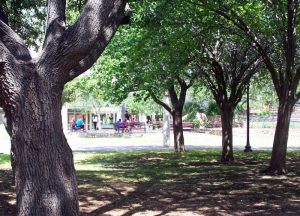
 A few of the exhibition spaces built for the Fair are still in daily use although perhaps for other than the original purpose – like the Lila Cockrell Theater and large parts of the convention center. The Institute of Texan Cultures was originally the State of Texas pavilion for the fair, and the round US District Court building was the United States of America pavilion – and the Mexican Cultural Institute is presently housed in the original, but expanded and renovated Mexico Pavilion. Others, like the Women's Pavilion are still there – but closed, pending restoration, or as support offices. One of the most eye-catching structures created for HemisFair is the "Tower of the Americas' – still about the tallest man-made building in San Antonio. Everyone should go up to the observation deck at least once, for nothing other than to admire the peerless view in every direction. It's also a very useful landmark for navigating around the city. The remaining grounds were re-landscaped with gardens, walkways and water-features in the mid-1980s ... but pretty much everyone acknowledges that unless there is some special event going on at the park, not many people are drawn to it – especially at night. In many ways, HemisFair Park is still a work in progress.
 HemisFair, although attracting a lot of attention and very well attended, unfortunately fell very short of breaking even. The fair also took a hit when it opened – two days after the assassination of Martin Luther King. Attendance never came close to matching estimates, and the Fair eventually lost over 7 million. Some of the local construction firms were owed substantial amounts by organizers; according to legend, they were paid with blocks of tickets – which they went out and sold on the street, recouping just enough from ticket sales to pay their suppliers and workers.